I just started this YouTube video , it starts with Chapter 4 and I quickly realized I’ve heard it before. (Warning: this is more of a Twitter post than a blog post…)
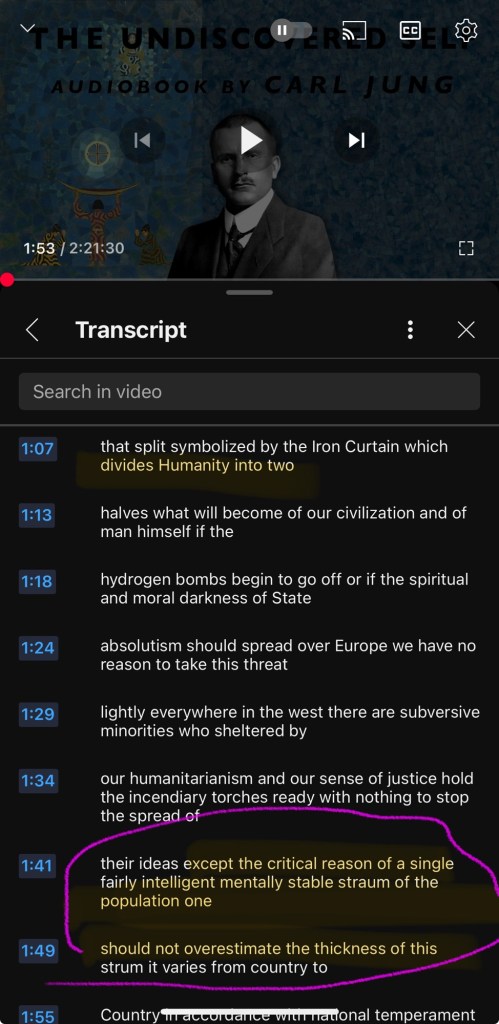
Carl mentions the iron curtain that divides humanity in two.
I’ve been actively not keeping up with the news. It’s inflammatory. It’s designed to be. My suspicion is, which I am not the first to express, it is stolen from some many people I imagine – my suspicion is the news is designed to raise blood pressure a) for engagement but also b) the poor Republicans hate the poor Democrats and vice versa. Who is left unhated on? And what news stories go unnoticed bc people are occupied by these strong gut feelings and beliefs around certain topics, that may not be unimportant, but they might be arguably less important than the news stories that don’t make the front page? While the insults are hurled by the powerless to the powerless, and thrown right back but with more force, like a Hatfield McCoy feud – while this feud rages, who sits on the the hill and watches the action while ordering rounds of lemonade (or maybe martinis and X-years-aged whiskey)
There is no more iron curtain. But people seem to be angry as ever, or more so, while no soldiers die, and less people live in abject poverty, we still divide ourselves 50/50.
Didn’t tribes divide into relatively equal numbers, a presumably ideal group number being about 120 or so if I recall? Did cities, provinces, towns develop into relatively equal numbers throughout history?
Say you are given a choice between joining a group of 40 or a group of 60? If it’s the Eve of a battle, perhaps you choose differently, but if you choose the group of 40 over the larger group, are your chances better that there will be a larger dinner portion assuming resources are somewhat equal? You have a better chance of being more relatively important in the smaller group right?
Like the Eve-of-Battle scenario, I could come up with many scenarios where the larger group is the way to go. Just a thought… hopefully the bot that reads the blog I haven’t posted in in x months enjoys it. Cross your fingers for me, hopefully I have more time for reading and writing in the not-so-distant future.
When he says “sheltered by our humanitarianism and sense of justice” – I think this could be misinterpreted, more or less taken out of context and used to justify negative feelings towards the other side, regardless of which side said justified sits on and which crap news station is the only one watched “in this household”
Both sides, all people in… the world – every single person KNOWS that they stand with the just, the people who see things as they are – and not with the dangerous imbeciles who deserve the harshest of penalties.
Carl had WW2 and the Cold War. But sometimes I wonder… on the surface things look very different but…how different, modern, “advanced” are we really? Are we still not dividing in two? To focus on only one thing of very many examples. Do the myths and symbols still not repeat themselves, very nearly unchanged, like a new coat of paint or a bi-monthly haircut?
***
I went to save that Carl video to watch later, I rarely click on these “short” videos (maybe it’s because of the Washington monument, perhaps the largest and most distinguished Freud/Carl coined ______ symbol in the world) – anyway… I watched it. Synchronicity seeming to actually be a thing, it is strangely applicable to this post.
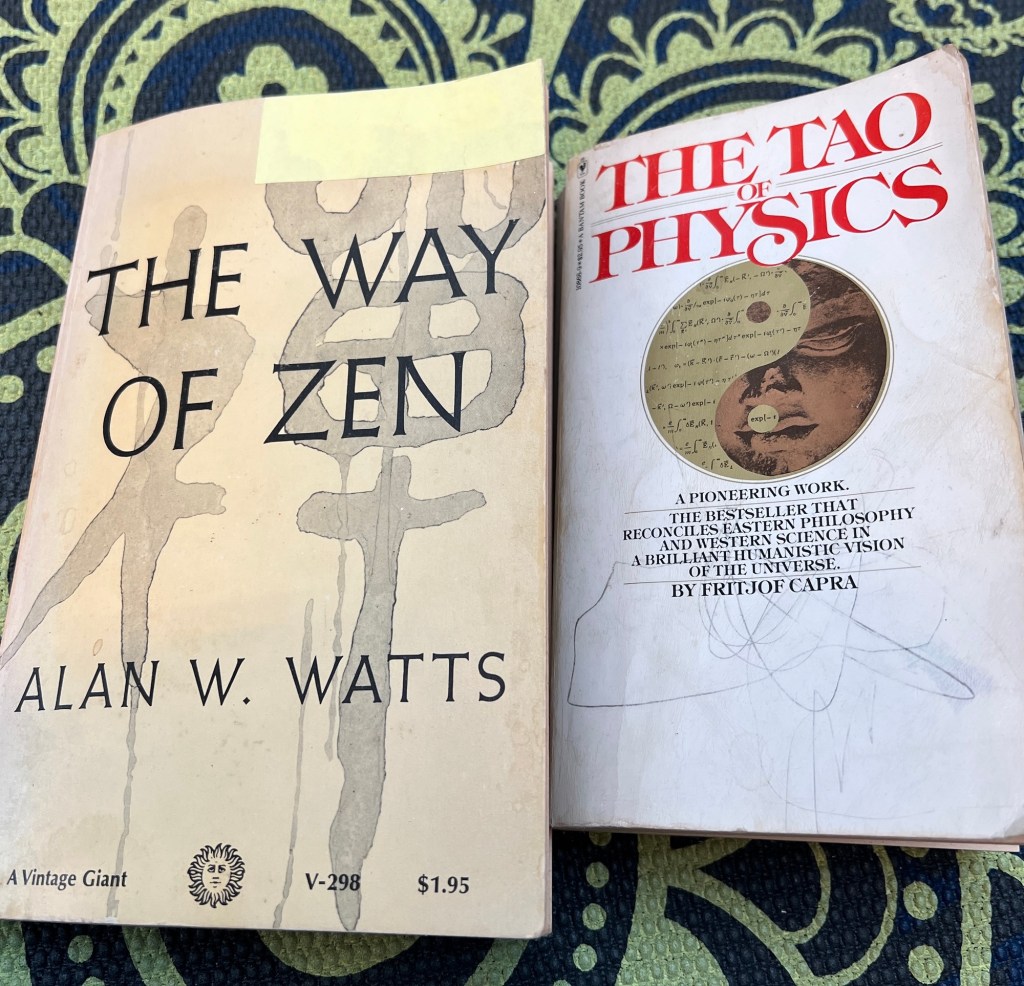
The Tao of Physics, Portrait of a Lady, and The Way of Zen
Fritjof Capra, Henry James, Alan Watts
– Fritjof Capra, The Tao of Physics– Alan Watts, The Way of Zen– Henry James, Portrait of a Lady
What can I possibly say to bring these together?
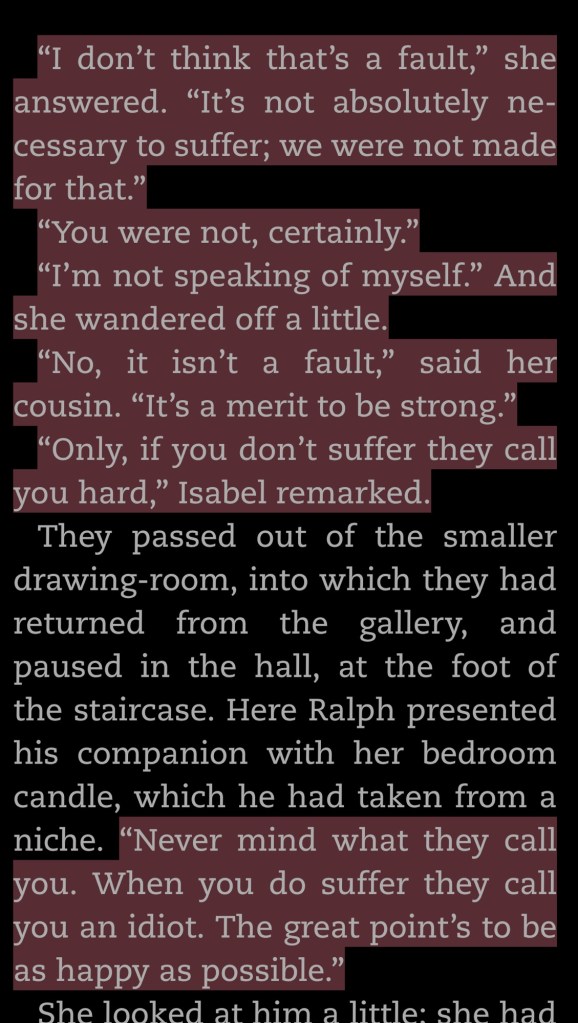
I did a good stint of suffering. And was indeed called a fool for it.
However… the most direct criticism of this nature – no, it wasn’t “of that nature” – that little “talk” can be boiled down to “you are a fool for suffering”
But I’m not so sure about that… Why am I being vague? I’m completely sure that suffering at that time was appropriate. I almost wrote “the right thing to do” – as if it was a choice.
Ok, let me drop the vagueness altogether. I’m writing about the first Christmas I was divorced and my father telling me that I should not be upset (he may as well have added “you’re bringing down my mood and I don’t like it.”
I would like to use the phrase “the ink was not dry” on my divorce papers but I don’t think they were signed. This was the same day I wired a good chunk of money to my ex wife.
That wire transfer stung, but let me interject here: a) it was a loan and b) my ex wife and I get along very well and c) as painful as that time was… I don’t think people believe me when I tell them that this stint of suffering was maybe, not “for the best” so much as… you never know what is good luck and what is bad luck and… Atman is the Brahman in our souls? Maybe I am writing this story and it’s a drama, not easily classified as a tragedy or a comedy, it is both.
Back to this unlovely conversation with my father: The man told me that he eventually chose (read “repressed”) his sadness after his divorce and that he regretted the time he “spent” upset, and so I should learn from his “mistake” and just skip the sadness (as I was ruining his Christmas – one would think I exaggerate but the man may be a true blue sociopath/psychopath)
I told him that I didn’t think he was correct that… one can just choose not to be sad, that the only thing to do when you’re upset is to be upset.
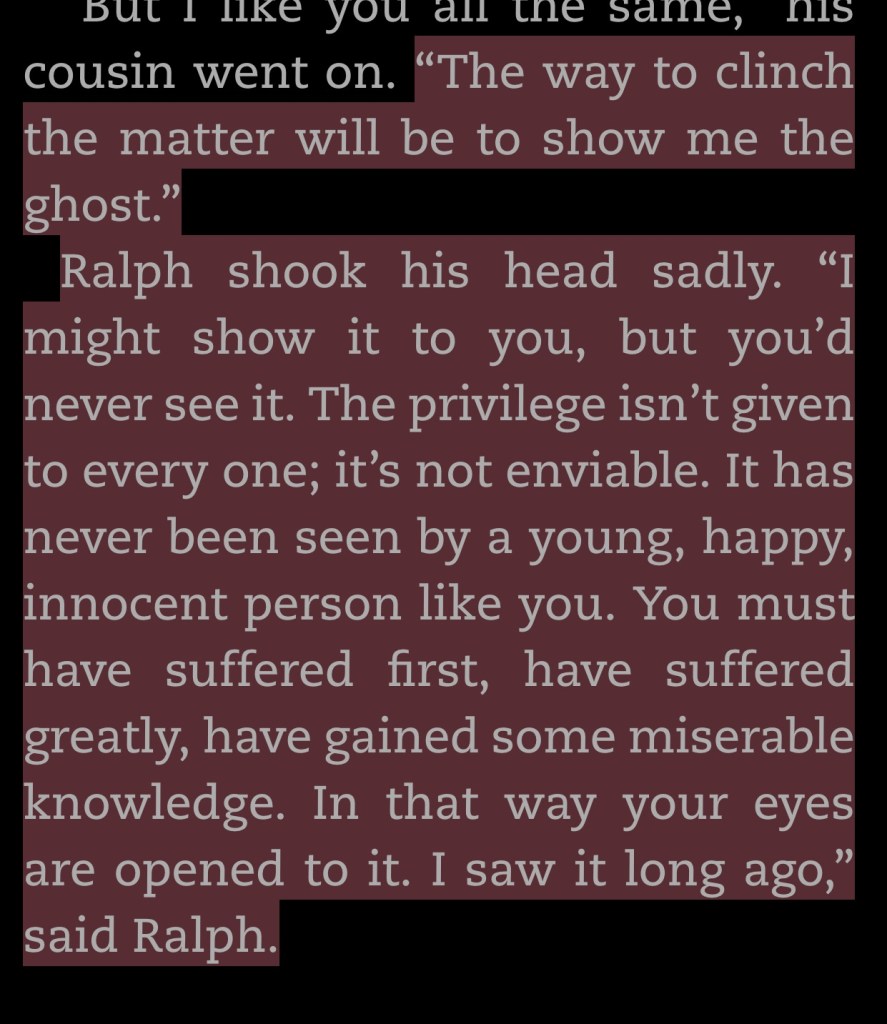
I don’t think I was eloquent enough at the time to conclude: and then it passes. It doesn’t really leave you, the past is what it is, but then that emotion doesn’t hide somewhere, buried in your subconscious, unresolved: an unsatisfied ghost that will haunt you, perhaps forever, a ghost, waiting for the opportunity to manifest itself.
Again from Portrait of a Lady:
I went inside, my father and had been on the porch, and some minutes later, I was sitting on the couch, an arm around each of my young children, when this psychopath came in and started screaming – ferociously: “YOU DIDN’T HELP SET THE TABLE! HOW COULD YOU DO THAT! WHY DID YOU NOT HELP SET THE TABLE!”
An unpleasant exchange of words followed and… it was nonsensical. My father and my (imbecile) stepmother seemed to somehow fault me further for not being completely cool with being screamed at, for being sad, in front of my two children.
I’ll leave out some unpleasant details but this was an incident where… I started to understand that my father is… he’s not just an a-hole, he has a very serious mental / emotional disorder that causes him tremendous pain and really defies understanding, or rather it is very hard to understand because on the surface it is so illogical. But it is a condition, a neurosis, that is unfortunately common among his generation: the child of Great Depression and World War II parents who did not, or were not capable of, showing love and affection at most likely an early stage of development, specifically ages 2 to 5.
Wowsers. I did not intend to write so much this morning, or share such personal details.
I’ve painted a good picture of myself as a victim. Yes, this particular event, I was not treated kindly.
C’est la vie.
I make light of it, but chances are, you have or will experience some traumas as well. I’m vague again: you will experience some traumatic events in your life. Everyone does. (I wonder what will befall Isabel…) So c’est la vie is appropriate.
I want to highlight what I tried to convey: on the surface, perhaps my father appeared more not-a-fool, more emotionally mature, but those repressed emotions from his divorce didn’t just go away and on this occasion they manifested themselves with him screaming like a lunatic at his son (that’s me), while I was upset about my divorce, and in front of his two young grandchildren at that.
So the real victim of his actions… is himself. He has to live with that. And the way he does that is by his tried and true methods of repression and projection. And… it hasn’t turned out well for him. “Own personal hell” I hear was how he described his day to day recently, now in the twilight of his life, the “golden years.”
So… writing this blog post: this is me not repressing these emotions. Am I a little sad now? Yup. But c’est la vie. If I’m going to bring it back to Zen and Taoism: Yin and Yang. If one is never sad, then happiness isn’t easy to come by either.
Paradox abounds: in this story I am both the victim and not. I can write about this and share it with anyone and not feel shame. And I can thereby recognize causes and effects and being conscious of these things, I can choose to treat my children differently – to not pass down these patterns of behavior from one generation to the next, as is usually the case.
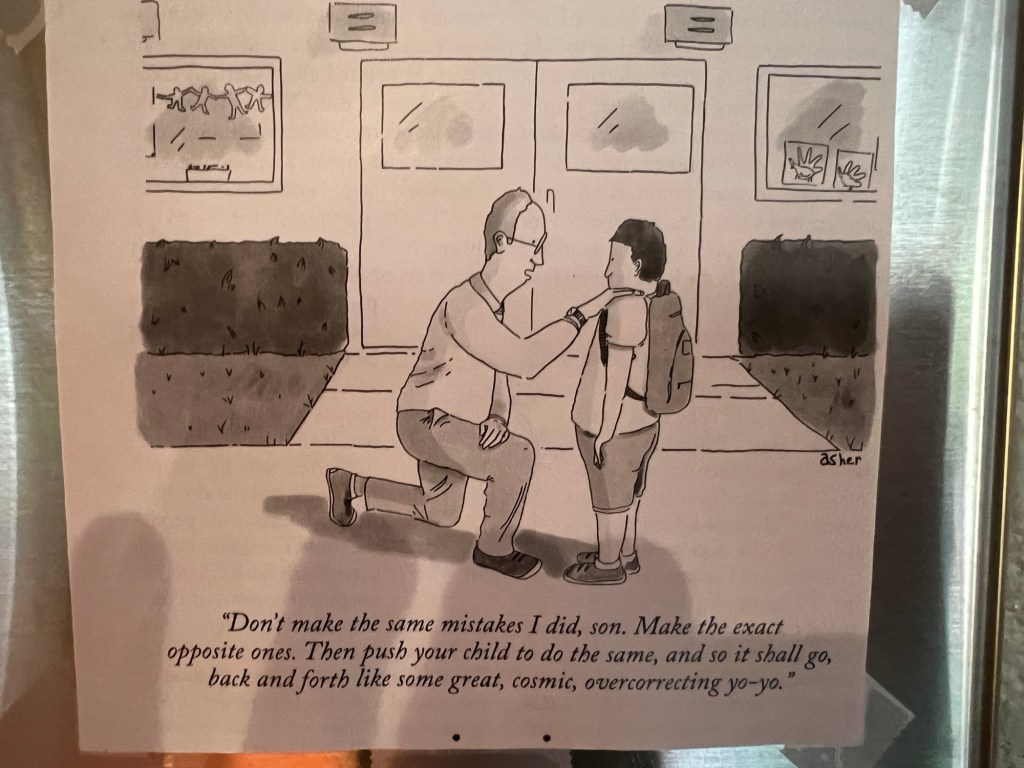
Ok to end on a lighter note, I’m not the only one who recognizes the faults of their parents, and the true challenge is one level deeper, and the goal is that the pendulum not swing too far in the other direction, as Jung has pointed out is often the case. The goal is to show my children balance and equanimity. At the risk of… am I saying this to convince myself of it or is it also the truth? I am not the victim of this story, I am the hero.
The lighter note! I saw this cartoon in The New Yorker recently, and as I find it pertinent, I cut it out and put it on the fridge.
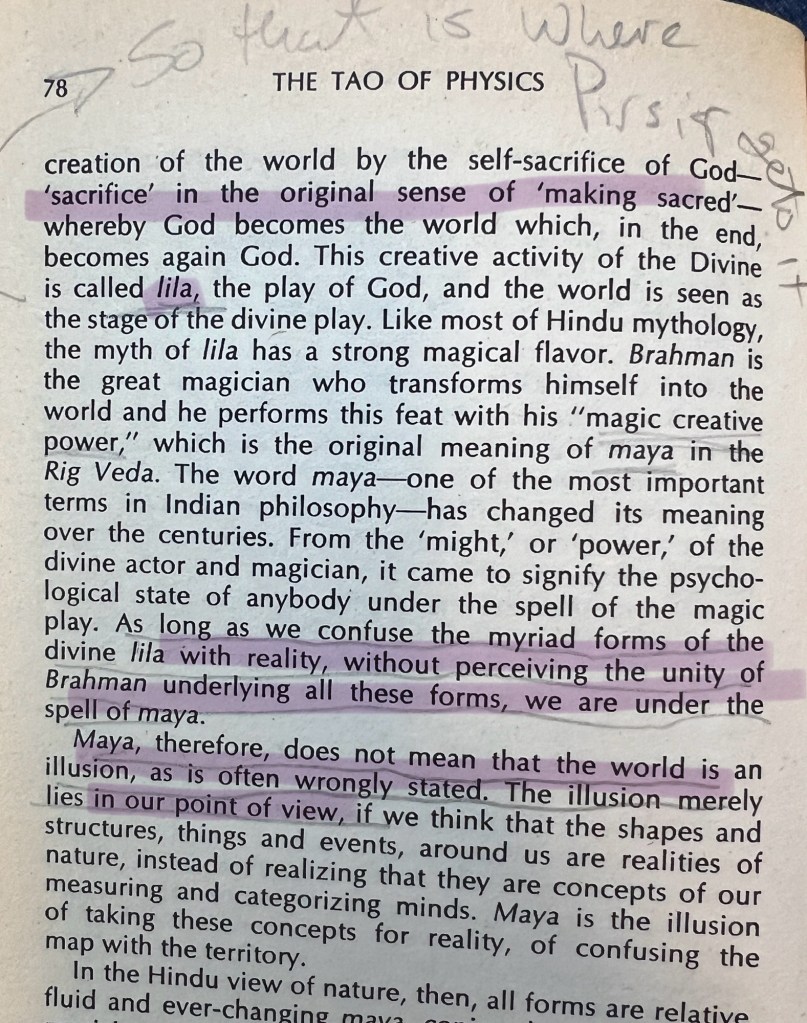
I almost forgot, as this post took a turn that veered from the subjects of these books… the note I scribbled in The Tao of Physics: Now I know the origin of Robert Pirsig’s next novel, Lila. Also, while some of these ideas are familiar, I found the bit about maya referring not to the world itself, but rather to our perception (or misperception of it) to advance my understanding of the subject a bit.
Ah! “The son of man hath no place to lay his head” – when I think back on the time in my life that I describe (detail…) in this post – that line really stuck with me, perhaps I had heard it in an Alan Watts lecture. At the time… I found it true but not particularly comforting. I’m not there yet but as Alan says: “This is The Gospel! This is the Good Word!” And while it can be interpreted somberly, it can be interpreted otherwise: as freedom.
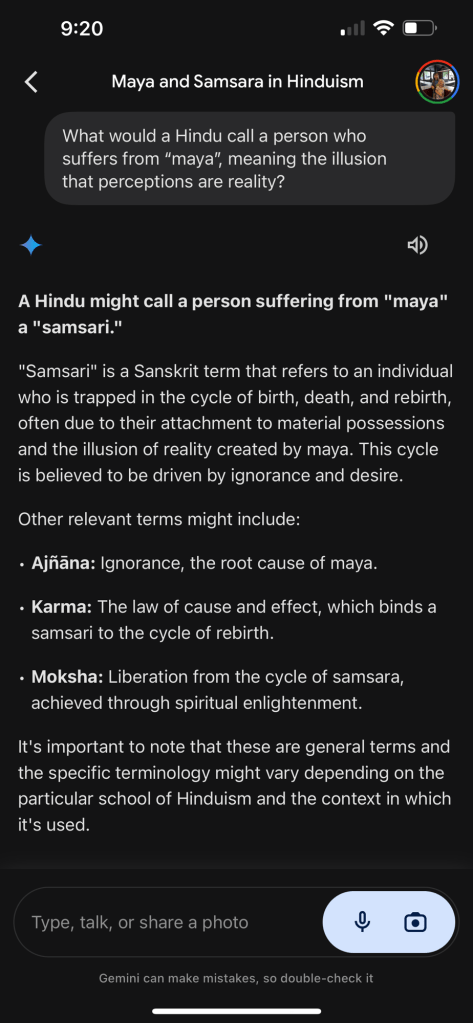
Ah! The title of this post: I’m using Google Gemini a bit lately to get a feel for how it compares to ChatGPT and I asked for the right word: Samsari.
I have often seen individuals simply outgrow a problem which had destroyed others. This ‘outgrowing’, as I formerly called it, on further experience was seen to consist in a new level of consciousness. Some higher or wider interest arose on the person’s horizon, and through this widening of his view the insoluble problem lost its urgency. It was not solved logically in its own terms, but faded out when confronted with a new and stronger life-tendency. It was repressed and made unconscious, but merely appeared in a different light, and so did indeed become different. What, on a lower level, had led to the wildest conflicts and to panicky outbursts of emotion, viewed from the higher level of the personality, now seemed like a storm in the valley seen from a high mountain-top. This does not mean that the thunderstorm is robbed of its reality, but instead of being in it, one is now above it.
I’m a bit ashamed to say that I have experienced “panicky outbursts of emotion”, quite recently as well.
I’m also proud of myself that I feel like I’ve made it out of the valley, albeit for only 48 (or maybe 47… or 46! weeks out of the year) Some of my family are still in the valley.
When I read Jung, I find things that help me transform my anger into pity. It wasn’t easy to get out of that valley. I remember a moment in time when I decided: “No! There is nothing wrong with me! I do not deserve to be treated this way by my father!” despite his repeatedly and consistently over many years telling me that there was something wrong with me every time I was angry with him.
Jung continues:
However, since we are both valley and mountain with respect to the psych, it might seem a vain illusion to feel oneself beyond what is human. One certainly does feel the affect and is shaken and tormented by it, yet at the same time one is aware of a higher consciousness, which prevents one from becoming identical with the affect, a consciousness which takes the affect objectively, and say, ‘I know that I suffer.’ What our text says of indolence: ‘Indolence of which a man is conscious and indolence of which he is unconscious are a thousand miles apart’, holds true in the highest degree of affect also.
I’m sometimes ashamed that I turn 43 in just days and I still find myself “in the valley” and swept away in a tidal wave of emotion. But I’m largely out of the valley and I’m also proud of myself for climbing out because I can easily imagine how some people never make it out.


 AwesomeWriters