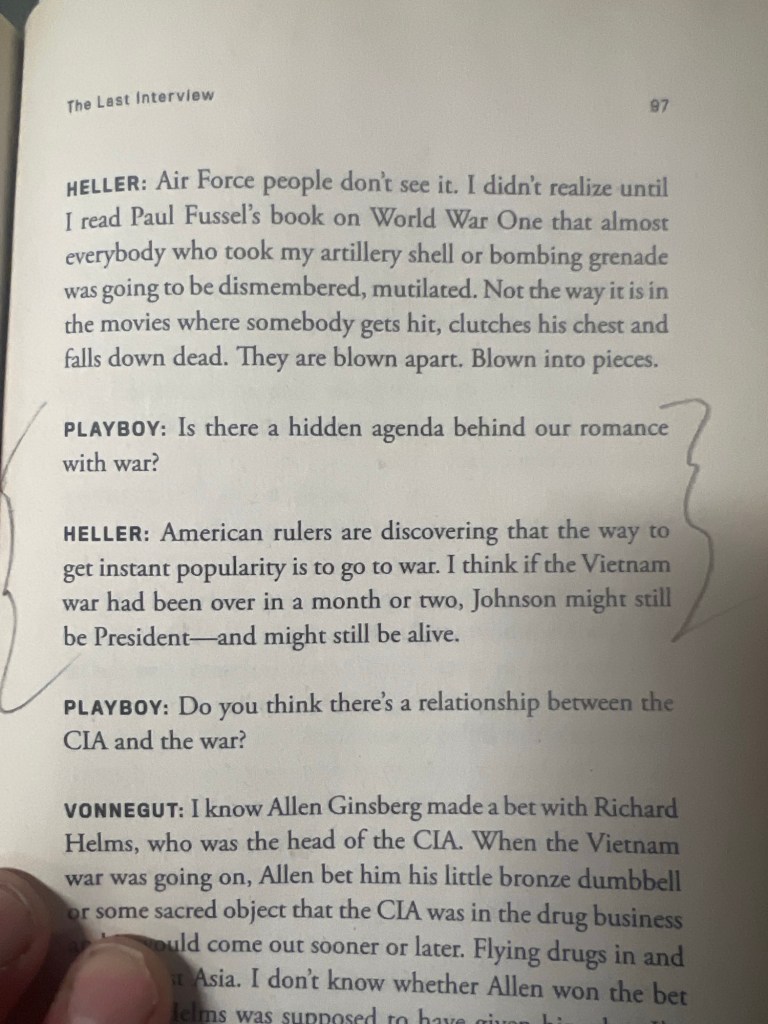
This is from the interview Playboy did with Vonnegut and Joseph Heller:
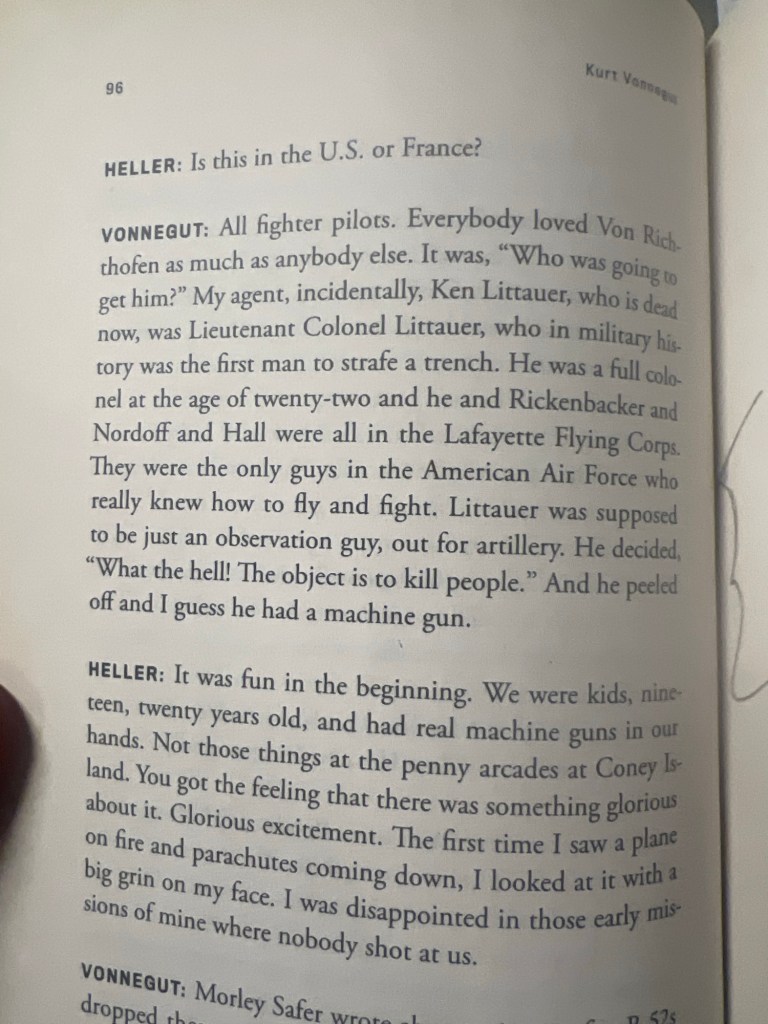
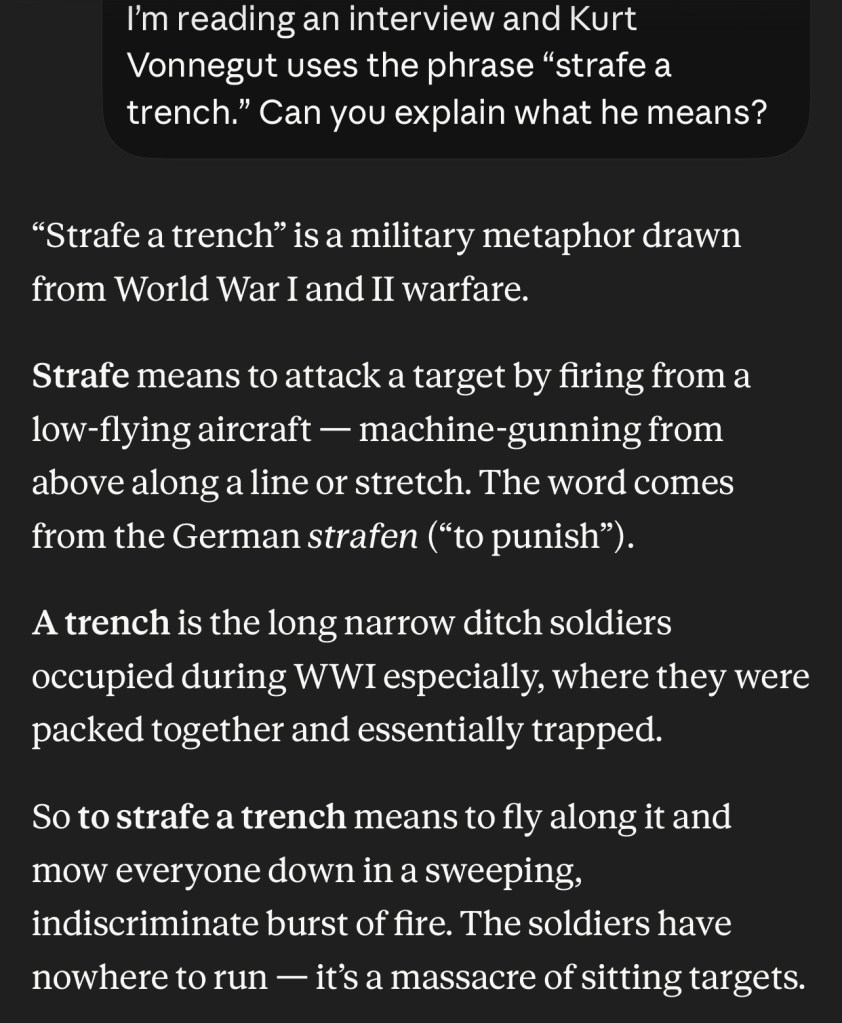
I didn’t know what it meant to “strafe a trench”:
We are what we pretend to be.
Joseph Heller
This is from the interview Playboy did with Vonnegut and Joseph Heller:
I didn’t know what it meant to “strafe a trench”:
We are what we pretend to be.
Joseph Heller
On the Nature of Things, Book 2
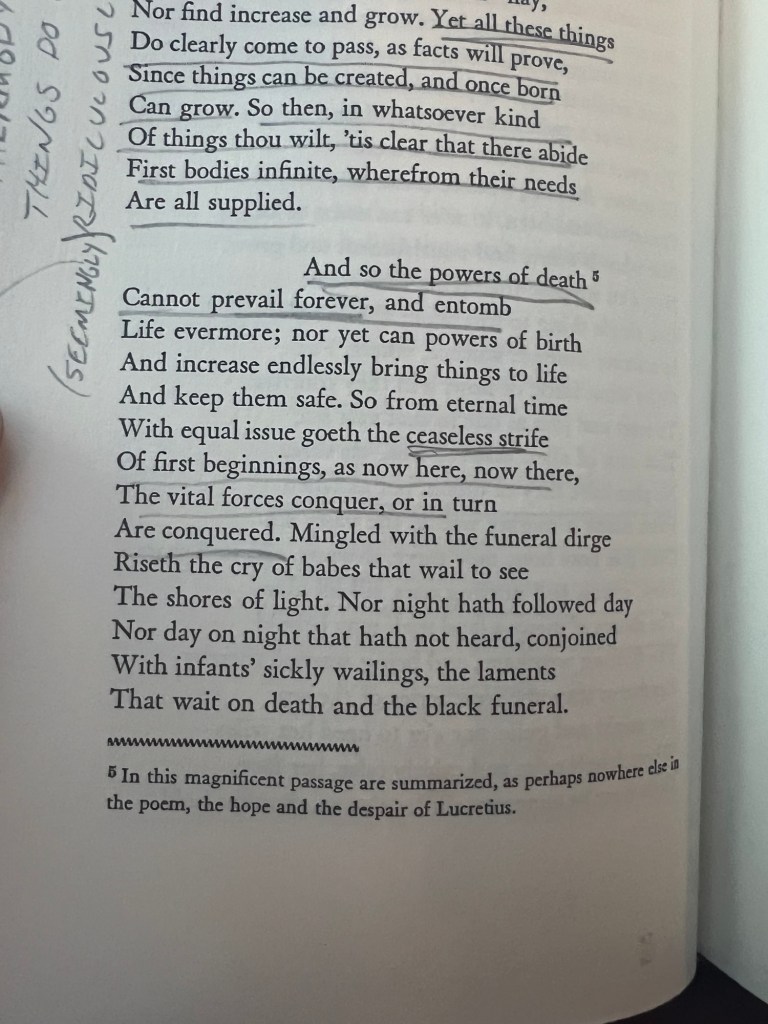
“The vital forces conquer, or in turn are conquered”
Apologies, if I get a chance (I’m lacking a keyboard at the moment) then I will include the text.
First thing – Lucretius is unbelievable prescient about some “modern physics” principles and ideas. The preceding paragraph, Lucretius is semi-concluding an exposition on what sounds like atoms, molecules and so forth.
The proofs are a bit different. No stats and figures, no spreadsheets, no citing of sources in fine print. So… does it count as science then? This is a whole different line of thought that I will cut short and say only: The Master and His Emissary is a book about the evolution of the human brain through history and the dude makes a compelling case for what I wish more people would see like a red barn – our period in human evolution, we’re too left brained, too much breaking things down into logical units, too much of an insistence that this the only “true knowledge” or “real science.” Iain McGilchrist is his name – smart dude, good book (but I confess, I listened to it, it’s kind of a long one) I hope Iain would not disagree with me saying that in that book he makes the case that the dominance of the left hemisphere of the brain (of the past couple hundred years, from the Enlightenment? Or Industrial Revolution? I forget exactly the “this current age” starts, anyway…) the prominence of the left brain and current beliefs about … knowledge, “real science”, etc etc – this is responsible for a lot of the big human problems in the world today.
The hemispheres, they need to “get their yin yang on” That is such a horrible sentence… but I’m going to let it be.
The paragraph from Lucretius – I read it to my son and asked a question or two to draw out “yin and yang!” The exclamation point is for dramatic effect, he was not ecstatic, FYI.
Philosophies and religions, when you left brain ‘em to their little units… Well, it is exactly like Lucretius is saying with “first bodies” forming ever more complex structures – from a couple of these “first ideas and beliefs”, you can build up the modern religion of your choice.
When I started thinking of a Christian principle-of-yin-and-yang example, I landed on the opposite – that bit about the rich guy getting more and more, and the little one with little has? That will be taken.
What’s a good Christian example? My readers (I’m partly writing this post bc I saw an email about a WordPress bill and I haven’t made a post in quite a while…) – I’m speaking to you (!), my large audience of adoring fans: please leave in the comments an example that illustrates how the concept of yin and yang is embraced in / by one of the worlds religions.
P.S. Lucretius here reminds me of Prospero (that’s right, I know the name of the character, no search required) with his “cloud cappd towers… all ye inherit, the great globe itself”, “pageant faded”, something about the actor’s vanishing into thin thin air…
Zen and the Art of Motorcycle Maintenance
By Robert M. Pirsig
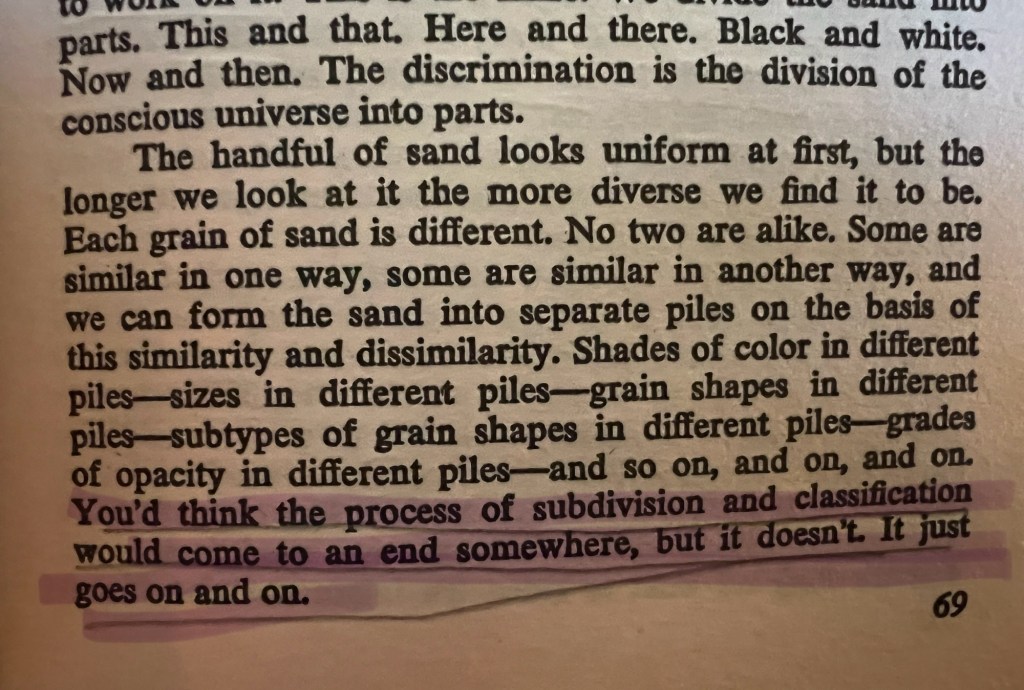
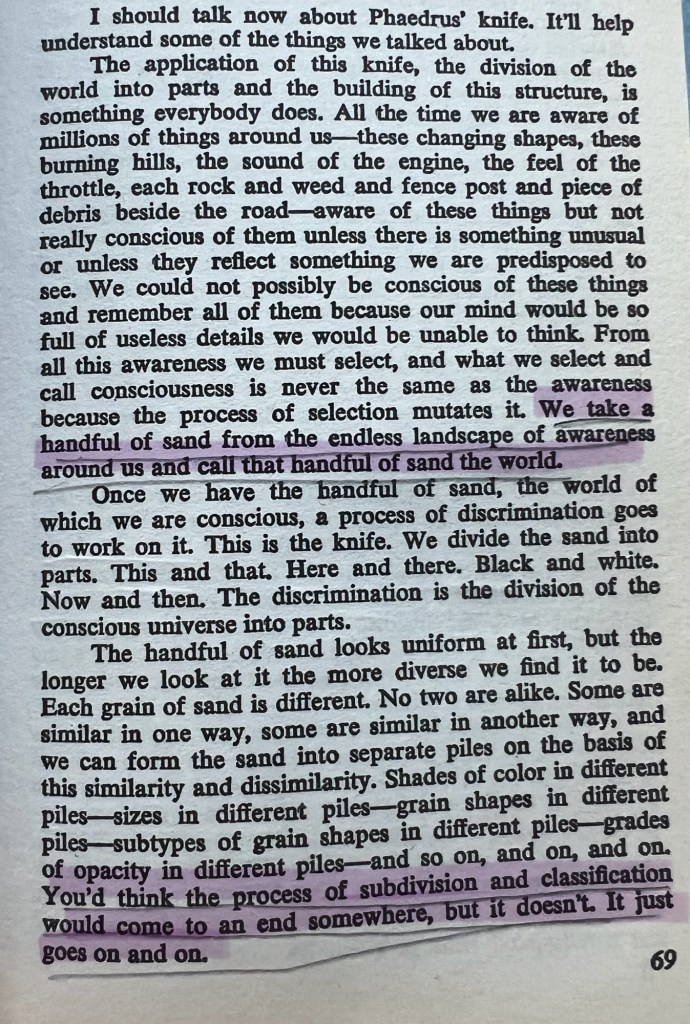
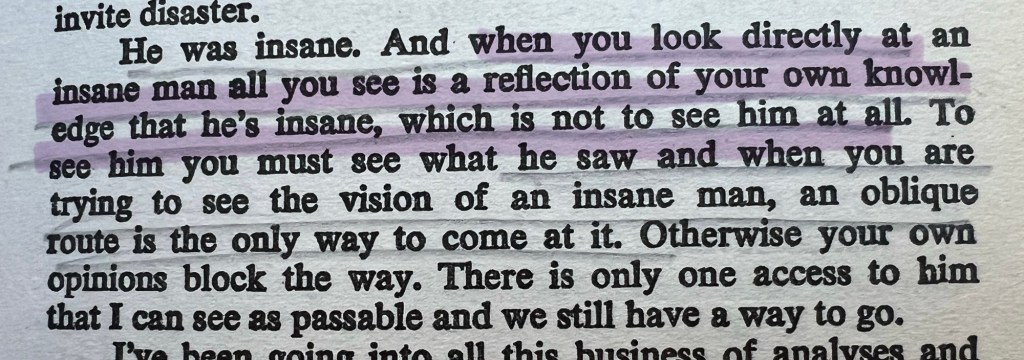
I’m trying to predict stock prices with AI. This quote is amazingly applicable, so much so that reading it yesterday borders on or sits in the big grey line that may classify an event as a Jungian synchronicity event.
(I think Carl might have erred slightly with that term… it’s hard to use and I think I used it incorrectly but I’m not sure how to correct it either: a semi-synchronicitic event? I’ve triggered spellcheck there…)
This reminds me of something I’ve heard Alan Watts say as well. I’m going to goof this “quote” a bit but it goes something like:
“We think of ourselves now as empirical and scientific but it is just an illusion. Because it’s impossible to analyze all the information pertinent to any decision – because the information is always infinite. The most careful, analytical, empirical, scientific person you can think of – they are just as impulsive as everyone else. You can analyze and think and analyze and think again and… eventually you just make a snap judgement.”
I shouldn’t put that in quotes… the main idea is the same and I think I got some of the words correct but… please don’t quote that quote.
When he mentions infinite information, he touches on the idea that we can never think of and analyze all of the things that may happen. This touches on the idea of “survivorship bias” – again, I should google or use chatgpt here to make sure I’m getting that term correct. There are so many Kahneman coined biases these days… I remember reading about this bias in a Nicholas Taleb book (I have a love / hate relationship with this guy – incredibly pompous and therefore off-putting but… his arrogance is… I don’t want to say it… at least partially justifiable.)
The idea there was: We read these books that promise to teach us how to achieve something. The author analyzed the big winners and they all did A, B, C… And so the conclusion is: do A, B, C and voila, pack your bags for Davos.
But what about all the people who did A, B and C and failed? Where is their lack of accomplishment recorded? Of course it isn’t.
One idea leads to the next and… this quote is from a chapter where Pirsig is explaining who Phaedrus was, what his ideas were about, and why he is important.
Phaedrus is a character in one of Plato’s Socrates dialogues. When I googled his name I thought it interesting that Pirsig and Zen and the Art of Motorcycle Maintenance was the third result. Not a lot of people reading Plato’s lesser known works these days… (perhaps this has always been true)
I thought it interesting that Pirsig calls Phaedrus insane, multiple times, and at the same time has tremendous admiration for him.
Which box is he in Robert?
Perhaps this is an example that relates directly to Pirsig’s discourse on the discourse.
Classify and analyze until the cows come home – Phaedrus doesn’t fit into one nice neat little box.
And perhaps that is true for every single thing – without exception – in the entire universe.
I will butcher another quote coined by I-forget-who: “There is only one true indivisible atom and it is the universe.”
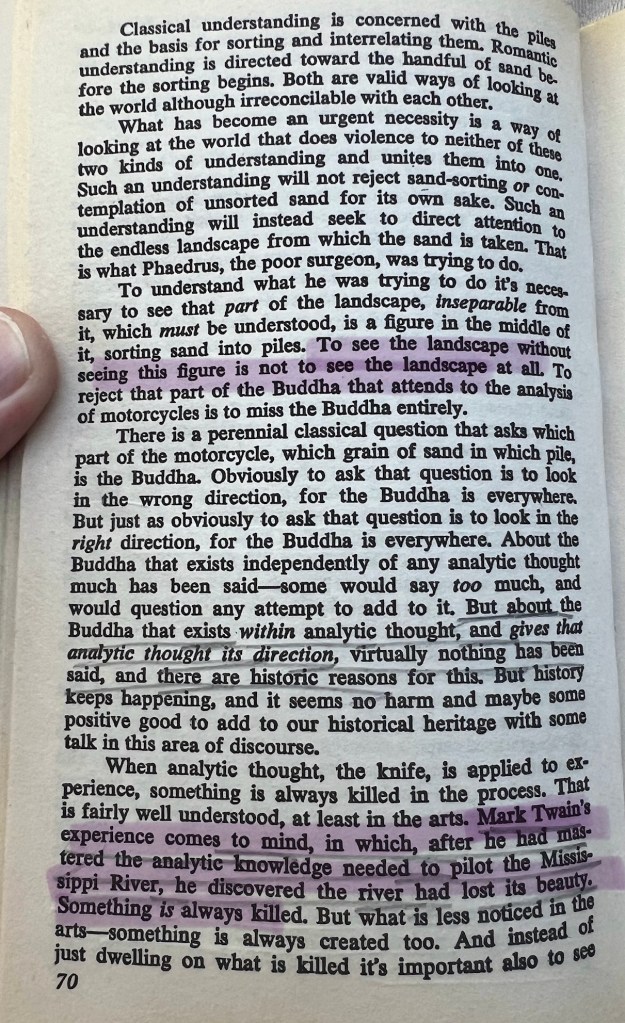
P.S. Here’s a couple more pages / paragraphs, the quote above right in the middle. I particularly enjoy the Mark Twain reference and I’ve wondered about this professional endeavor of mine, analogous to Frodo’s little walk to Mordor: by the time I’m done with this thing, and to generously assume I’m successful, am I still going to have the time to enjoy myself and that success? Is my life passing me by while I fight with this giant beast of a number cruncher that I’ve built? Am I dedicating too much of myself and my time to abstractions of abstractions of abstractions… as my view of the landscape progresses ever further out of focus? Oof. That’s a bit of a grim way to end this post especially when my next activity is to hike down to the basement and work on this number cruncher…
Nothing fits neatly into any box. Paradox seems to both plague and invigorate, completely pervasive and never present.
Ok… time to crunch some numbers…
“But why on earth, you might ask, should it be necessary for man to achieve, by hook or by crook, a higher level of consciousness?
This is truly the crucial question, and I do not find the answer easy. Instead of a real answer, I can only make a confession of faith. I believe that, after thousands and millions of years, someone had to realize that this wonderful world of mountains and oceans, suns and moons, galaxies and nebulae, plants and animals, exists.
https://youtu.be/Iyvnukd3qQY?si=xfsXWL4Cgo4J_1Kg
(3 hours and 48 minutes in)
This one was earlier in the video and is one of those quotes you would think someone said yesterday, if we paid a fraction of the attention to intellectuals. But is there anyone who speaks like this anymore? Why do I have to go back 50 or 60 or 70 years for a good quote? Maybe it has something to do with WW2 and the Cold War after. Finally, the quote:
We have let the house our fathers built fall into decay, and now we try to break into Oriental palaces that our fathers never knew. Anyone who has lost the historical symbols and cannot be satisfied with substitutes is certainly in a very difficult position today: before him there yawns the void, and he turns away from it in horror. What is worse, the vacuum gets filled with absurd political and social ideas, which one and all are distinguished by their spiritual bleakness.
Nietzsche, Thus Spake Zarathustra, XXXIV. SELF-SURPASSING
In a text to a friend this morning I wrote: Nietzsche dude. A paradox. A wonderful horrible man. A terrible genius.
Again, this idea of paradox being at the heart of reality. From a very different author and prophet, Eckhart Tolle, I heard a quote in one of his guided meditations recently, something like: “If it’s not a paradox then it is not the deepest truth.”
Can’t have a Nietzsche blog post without mentioning “God is dead.” Carl Jung observed that that was more of an observation than a proclamation or commandment. Still I wonder how much of WWII one can lay at Nietzsche’s feet with all his “Uber mench” talk, and the stuff about destroying the world before building it anew. Mostly I credit deviants who claim Nietzsche as their leader as having a shallow understanding of his ideas, picking and choosing this or that phrase like a Republican picks from the Bible.
Still…
“Hearken now unto my word, ye wisest ones! Test it seriously, whether I have crept into the heart of life itself, and into the roots of its heart!
Wherever I found a living thing, there found I Will to Power; and even in the will of the servant found I the will to be master.
That to the stronger the weaker shall serve—thereto persuadeth he his will who would be master over a still weaker one. That delight alone he is unwilling to forego.”
– Nietzsche, Thus Spake Zarathustra, Chapter 34: Self-Surpassing
https://www.gutenberg.org/files/1998/1998-h/1998-h.htm#link2H_4_0040
https://books.google.com/books/about/Thus_Spoke_Zarathustra.html?id=a9VxKgui0mEC
Joyce Carol Oates’s Relentless, Prolific Search for a Self by Rachel Aviv
In a letter to the editor, Oates responded, “Since critics are constantly telling me to ‘slow down,’ I must say gently, very gently, that everything I have done so far is only preliminary to my most serious work.” She went on, “There is a sense in which ‘I’ do not exist at all, but am a process recording phases of American life.”
– Rachel Aviv quoting Joyce Carol Oates
This quote fits nicely into the theme of recent blog posts and Eastern Philosophy.
From my main man Alan Watts:
We suffer from a hallucination, from a false and distorted sensation of our own existence as living organisms. Most of us have the sensation that ‘I myself’ is a separate center of feeling and action, living inside and bounded by the physical body — a center which ‘confronts’ an ‘external’ world.
– Alan Watts
I thought I read something in Carl Jung’s introduction to The Secret of the Golden Flower but something more directly applicable I must have come across somewhere else (or not noted…) I’ve got that book in front of me so… talking about “Wu Wei” (a.k.a “going with the flow”) and this quote about something that breaks one out of a psychological conflict:
In no case was it conjured into existence through purpose and conscious willing, but rather seemed to be born on the stream of time.
– Carl Jung in the introduction to The Secret of the Golden Flower
Later Aviv quotes Oates:
She dragged herself to the typewriter each morning to “write it all out, somehow, anyway, thinking I might as well get some use out of going mad,” she told Godwin.
– Rachel Aviv quoting Joyce Carol Oates
The correct word to describe Oates’ career seems to be “prolific.” I will have to pick out one of her many books. She may still have questions about the self but… that’s good. I hope she keeps up her pursuit. Maybe times answers her questions but… I hope it takes some time.
The shadow is often project on to others. Examination of those attributes which a man most condemns in other people (greed, intolerance, disregard for others, etc.) usually shows that, unacknowledged, he himself possesses them.
– C.G. Jung
Unfortunately there can be no doubt that man is, on the whole, less good than he imagines himself to or wants to be. Everyone carries a shadow, and the less it is embodied in the individual’s conscious life, the blacker and denser it is. If an inferiority is conscious, one always has a chance to correct it. …. But if it is repressed and isolated from consciousness, it never gets corrected, and is liable to burst forth suddenly in a moment of unawareness.
– C.G. Jung
Side anecdote: I was bringing this book into the sauna and this dude said “Hey… you read Jung! I went to a liberal arts school.” I told him I had read “Memories, Dreams, Reflections” recently. He told me he had the book.
At this point I started to get the feeling that he might have a lot of books but read very few (alas, like the quote above, I am guilty of the same and so find it unbecoming.)
Then he told me that I shouldn’t bring the book into the sauna because it could ruin the binding. I said that I was just going in for a couple minutes and that it should be fine. Then he added: “You know… I’m saying this as a lover of books…” As if I am not one!
I wasn’t quick enough, and I wouldn’t have said anything anyway, but it would make a good story if I had retorted: “Oh, well then, you should try reading one.”
I picked up Swedenborg: Buddha of the North when we were browsing the book store for Christmas gifts. I’ve heard Alan Watts mention his name in many lectures and I’ve heard him referenced by others as well. Looking at another title on Thriftbooks, I see it was published first in 1955. My understanding is that Suzuki was among the cohort of philosophers who made popular Eastern Religions to the open minded peoples of the 1960s, a.k.a. The Hippies.
Swedenborg seemed to be the most exotic of the choices at Used Books. Two quotes caught my attention:
There are enough in one century who pold on in the old beaten track, while there are scarcely six or ten in a whole century, who are able to generate novelties which are bard upon argument and reason.
Emanuel Swedenborg
I believe here he is referencing some of his inventions rather than his literary and philosophical works. He was apparently somewhat of a polymath with interested ranging from mathematics to metallurgy and then to, what he is most known for, speaking with the dead in both heaven and hell, and espousing their opinions, and what especially caught people’s attention: espousing how they had changed their opinion after death.
Apparently he spoke of these sojourns and conversations in other realms in a deadpan serious way, as if they were… mundane experiences. Suzuki comments on how this may have been interpreted.
Another bit that caught my attention: he fell in love with the eldest daughter of Christopher Polhem, an engineer and his mentor. The marriage was sanctioned by Polhem and the king. But a couple years later, the daughter did not want to marry Swedenborg anymore and so he “relinquished his claim” on her (how thoughtful of him).
The quote:
Throughout the rest of his life, he never thought again of marriage, but single-mindedly pursued his studies. As a result of this rebuff, he ended up gaining a lifetime free from encumbrances and came to think of nothing else but the divine will. It may be, then, that the divine will was at work from the start.
– Suzuki
I’ve heard that some philosopher’s and monks have adopted a solitary life not out of a vow of chastity but because it is “terribly convenient not to have a wife.”
Well… thanks Swedenborg. I think I prefer my wife and family though to conversations with dead people in various levels of heaven and hell. I joke…
It reminds me of what I’ve said about Elon Musk: I’m glad he exists and I’m very glad that I am not him.
Sometimes people make advancements and have great insights but I wonder at what cost. I don’t doubt that I will learn much from Swedenborg and Suzuki alike reading this book. But I wonder… was he driven mad by loneliness?
If so, I pity him, and hope to honor him by learning what I can from his… unique (unique seems not quite the right word…) life. Another example perhaps of the fine line between madness and genius.
This quote about Israel captured my attention because of the war that broke out these past couple weeks. I’m astounded that this psalm was so prescient.
More and more, the scientists are saying that man must now take his future evolution into his own (i.e., the ego’s) hands, and rely no longer upon the caprices of “natural selection.” Yet those who speak thus do not seem to realize that this is going to require increasing violence against “deviant” forces within the individual and within society. The aspiration to direct evolution is also the aspiration to be “as God,” and thus—as God is generally conceived in the West—to be dictator of the world.
But, as the psalm says, “Behold, He that keepeth Israel shall neither slumber nor sleep.” This is really the same as the saying that “There is no peace for the wicked,” for those who, like the tyrant-image of God, take the law into their own hands. For our traditional model of the universe is basically military.
– Alan Watts, Does It Matter?, The Spirit of Violence and the Matter of Peace
A couple pages later this paragraph caught my attention:
Only a supernaturalist would deliberately press the button to set off nuclear warfare, in the belief that his spiritual values are more important than material existence. And this involves the open or tacit supposition that the spiritual dimension is immortal, that in heaven or on some higher level of vibration unaffected by bodily death he will continue his existence, congratulating himself on his fidelity to principle and wagging the finger of reproof at the surprisedly immortal souls of dialectical materialists, eating crow in the sky instead of pie. This simply goes to show that belief in the superiority and final authority of the rational, intellectual, conceptual, and symbolic domain as the ultimate reality may be inconsistent with the survival of mankind.
– Alan Watts, Does It Matter?, The Spirit of Violence and the Matter of Peace
It is perhaps the truth that the most horrible people have the best intentions.
I’m reminded of Alan when he talks about the priests who burned people at the stake in the hopes that they would repent because they truly believed that they had a chance of saving them from eternal damnation.
“Kindly let me help you or you will drown said the monkey putting the fish safely up a tree.”
– Alan Watts (Goodreads.com link)
I picked this up at Powell’s City of Books in Portland because it’s been referenced in so many things that I’ve read, most recently Memories Dreams Reflections by C.G. Jung.
What good is my virtue! As yet it hath not made me passionate.
Thus Spake Zarathustra by Friedrich Nietzsche
This quote stood out to me because I had a conversation recently with a friend where we came to the conclusion that the most important thing in life is to be passionate (about anything). The context was that I was criticizing a friend for his lack of passion for his work, the only passion being money and security; a desire to keep everything the same, to stop life from changing, which is impossible, and a rejection of what it means to live. Life is change. And I’m reminded of Jung: “Anyone who takes the sure road is as good as dead.”
At some age it becomes impossible for someone to question their big decisions and beliefs. It becomes too painful to accept a serious mistake in judgement that has had a profound effect on one’s life. If one is confronted with this situation it could mean the collapse of the ego and a total mental breakdown. The ego and the mind protect itself. And so the big things are not questioned in our later years, and so I think it is important to constantly question yourself and your beliefs and have your life be a semi-continuous stream of improvement and modification of beliefs. Or else be crushed by the consequences of not doing so.
“A child has Zarathustra become; an awakened one is Zarathustra: what will thou do in the land of the sleepers?”
Thus Spake Zarathustra by Friedrich Nietzsche
This line makes me wonder about how much exposure Nietzsche had to Eastern religions: Hinduism, Buddhism, Confucianism, Taoism. ” “Awakened” is an adjective that I associate with “enlightenment” and these Eastern religions. And the idea that the highest achievement is to retain a “child’s mind” I associate with Buddhism and the acceptance and belief that our reality is pattern and change and nothing is eternal. This is related to the first quote / idea I mentioned above, that it is best to continually evolve over the course of one’s life.
“Believe not those who speak unto you of superearthly hopes! Poisoners are they, whether they know it or not.. Despisers of life are they.”
Thus Spake Zarathustra by Friedrich Nietzsche
I would like to leave this quote as a comment on one of my “born again” Facebook friend’s posts. But I won’t. It would be too much. Which brings me back to that idea that at some point… it’s better not to question the big decisions but rather to just “ride it out” to the grave.
I’m reminded of Homo Deus by Yuval Noah Harari where he writes a bit about how the father who sends his son off to war and then to have him be killed, the father only becomes more patriotic, can only support the nation and the war more. It is too much to accept that the decision and initial judgement was foolish. Also, not wearing masks during Covid, anyone who took this position and then had a relative die of Covid… the only thing that makes sense is to hate Fauci and the CDC more, it’s too much to accept that a different decision could have prevented the death of a loved one…
This post got a little dark… My first impressions are that Zarathustra was a good buy and I expect I’ll find hundreds of quotes that could warrant a blog post each. Even after the first couple pages, I just picked out a couple of the quotes I underlined.

