AwesomeWriters

  • Is 50/50 Division Human NatureFebruary 28, 2025
    I just started this YouTube video , it starts with Chapter 4 and I quickly realized I’ve heard it before. (Warning: this is more of… Read more: Is 50/50 Division Human Nature
  • A Frightening VacuumSeptember 28, 2024
    Zen and the Art of Motorcycle Maintenance Robert M. Pirsig I’m starting a company in the near future and I haven’t done much pitching it.… Read more: A Frightening Vacuum
  • A Strange Mix: The Suffering Samsari Hath No Place to Lay His HeadSeptember 15, 2024
    The Tao of Physics, Portrait of a Lady, and The Way of Zen Fritjof Capra, Henry James, Alan Watts What can I possibly say to… Read more: A Strange Mix: The Suffering Samsari Hath No Place to Lay His Head
  • Fanatical Doubt: Who comes to mind?September 14, 2024
    Zen and the Art of Motorcycle Maintenance Robert Pirsig Who comes to mind when you read that? What group or type or organization of people… Read more: Fanatical Doubt: Who comes to mind?
  • Portrait of a Lady: A Couple QuotesSeptember 12, 2024
    By Henry James Like Isabel, Henry James is bestowed with great felicity. (I had to look that one up) I have The Harvard Classics on… Read more: Portrait of a Lady: A Couple Quotes
  • Speech Writer PunchlineSeptember 1, 2024
    Zen and the Art of Motorcycle Maintenance Robert M. Pirsig
  • Endless ClassificationAugust 31, 2024
    Zen and the Art of Motorcycle Maintenance By Robert M. Pirsig I’m trying to predict stock prices with AI. This quote is amazingly applicable, so… Read more: Endless Classification
  • Because Your Dream is so BigAugust 20, 2024
    Grit by Angela Duckworth I had to put on a motivational video just now, below is a clip that applies to my current project: https://youtube.com/clip/UgkxzkpXhxjvjz1lkos4bfh-Za9HT3GpD7-o?si=Q3FixOp68v9bjF-e… Read more: Because Your Dream is so Big
  • 90% is HalfAugust 19, 2024
    Zen in the Art of Archery By Eugen Herrigel I’ve found this proverb to be true in endurance exercises and work. The Seattle to Portland… Read more: 90% is Half
  • The Buddha ResidesAugust 15, 2024
    Zen and Art of Motorcycle Maintenance By Robert M. Persig Reminds of one of my favorite quotes: “The unnatural, that too is natural” – Johann… Read more: The Buddha Resides
  • By hook or by crook (Carl Jung quote)August 13, 2024
    “But why on earth, you might ask, should it be necessary for man to achieve, by hook or by crook, a higher level of consciousness?… Read more: By hook or by crook (Carl Jung quote)
  • Zarathustra: Self-SurpassingMay 14, 2024
    Nietzsche, Thus Spake Zarathustra, XXXIV. SELF-SURPASSING In a text to a friend this morning I wrote: Nietzsche dude. A paradox. A wonderful horrible man. A… Read more: Zarathustra: Self-Surpassing
  • I Do Not ExistDecember 8, 2023
    Joyce Carol Oates’s Relentless, Prolific Search for a Self by Rachel Aviv In a letter to the editor, Oates responded, “Since critics are constantly telling… Read more: I Do Not Exist
  • The Thunderstorm in the ValleyNovember 28, 2023
    Carl Jung in the Introduction to The Secret of the Golden Flower I have often seen individuals simply outgrow a problem which had destroyed others.… Read more: The Thunderstorm in the Valley
  • The Shadow ProjectedNovember 21, 2023
    The shadow is often project on to others. Examination of those attributes which a man most condemns in other people (greed, intolerance, disregard for others,… Read more: The Shadow Projected
  • Swedenborg: Buddha of the NorthNovember 21, 2023
    By D.T. Suzuki I picked up Swedenborg: Buddha of the North when we were browsing the book store for Christmas gifts. I’ve heard Alan Watts… Read more: Swedenborg: Buddha of the North
  • Behold, He that keepeth Israel shall neither slumber nor sleepOctober 25, 2023
    Excerpt from the essay The Spirit of Violence and the Matter of Peace in Does It Matter? by Alan Watts This quote about Israel captured… Read more: Behold, He that keepeth Israel shall neither slumber nor sleep
  • First Impressions: Thus Spake Zarathustra by Friedrich NietzscheJuly 19, 2023
    A couple quotes from the prologue I picked this up at Powell’s City of Books in Portland because it’s been referenced in so many things… Read more: First Impressions: Thus Spake Zarathustra by Friedrich Nietzsche
  • Startup TeamsJune 12, 2023
    Notes on the chapter “The Mechanics of Mafia” from “Zero to One: Notes on Startups, or How to Build the Future” by Peter Thiel “‘Company… Read more: Startup Teams
  • Four Pebbles Guided Meditation with Thich Nhat HanhJune 12, 2023
    This was a nice guided meditation. I like Thich Nhat Hanh‘s guided meditation. The videos I’ve seen, even when he is giving a talk that… Read more: Four Pebbles Guided Meditation with Thich Nhat Hanh
  • You’ve Lost EverythingJune 7, 2023
    Excerpt from “The Tibetan Book of Living and Dying” by Sogyal Rinpoche “You’ve lost everything. Your restless, agitated mind is then stunned, and thoughts subside.… Read more: You’ve Lost Everything
  • The Liberating WheelchairApril 11, 2023
    “Atomic Habits” by James Clear I once heard a story about a man who uses a wheelchair. When asked if it was difficult being confined,… Read more: The Liberating Wheelchair
  • Understanding Simultaneity is like Understanding that “up” and “down” are Relative?March 25, 2023
    “Anaximander and the Birth of Science” by Carlo Rovelli The difficulty in understanding the complexity of the notion of simulataneity in Einstein’s theory is very… Read more: Understanding Simultaneity is like Understanding that “up” and “down” are Relative?
  • The Next Few Seconds Were UnforgettableMarch 22, 2023
    “Touching the Void: The True Story of One Man’s Miraculous Survival” by Joe Simpson The next few seconds were unforgettable. I was inside a protective… Read more: The Next Few Seconds Were Unforgettable
  • Monopolies Are GoodMarch 20, 2023
    “Zero to One” by Peter Thiel When I mentioned to some friends (they’re real, I swear!) that I was reading Peter Thiel’s book, the first… Read more: Monopolies Are Good
  • Focus Your AttentionMarch 20, 2023
    “Journey to Ixtalan” by Carlos Castaneda “Focus your attention on the link between you and your death, without remorse or sadness or worrying. Focus your… Read more: Focus Your Attention
  • Lady Marian is a FirecrackerMarch 16, 2023
    Roger Lancelyn Green: The Adventures of Robin Hood My kids are 7 and just shy of 10 years old and The Adventures of Robin Hood… Read more: Lady Marian is a Firecracker
  • Anaximander thought of Evolution?!?March 14, 2023
    Excerpt from “Anaximander and the Birth of Science” by Carlo Rovelli There is another area in which Anaximander’s naturalism appears to be of nearly miraculous… Read more: Anaximander thought of Evolution?!?
  • Anyone who takes the sure road is as good as deadMarch 14, 2023
    “Memories Dreams Reflections” by Carl Jung, “Visions” chapter “Anyone who takes the sure road is as good as dead” is the most poignant and pithy… Read more: Anyone who takes the sure road is as good as dead
  • Hunting the White FalconMarch 12, 2023
    Excerpt from “Journey to Ixtlan” by Carlos Castaneda It all began with my grandfather’s explosion of anger upon taking a count of his young Leghorn… Read more: Hunting the White Falcon
  • Beck Weathers SurvivesMarch 9, 2023
    Excerpt from “Into Thin Air” by Jon Krakauer The first body turned out to be Namba, but Hutchison couldn’t tell who it was until he… Read more: Beck Weathers Survives
  • Excerpt from Memories Dreams Reflections by Carl JungMarch 9, 2023
    “From Tozeur I went on to the oasis of Nefta. I rode off with mydragoman early in the morning, shortly after sunrise. Our mounts were… Read more: Excerpt from Memories Dreams Reflections by Carl Jung
  • Man the Reformer by Ralph Waldo EmersonFebruary 28, 2023
    Lecture Read before the Mechanics’ Apprentices Library Association, Boston, Jan 25, 1841 The cynical take on this lecture is: if man is so great at… Read more: Man the Reformer by Ralph Waldo Emerson
  • Excerpt from Doctor Zhivago by Boris PasternakFebruary 28, 2023
    When I searched this quote, it looks like the second paragraph has been picked out often, but the first paragraph gives a little context: “But,… Read more: Excerpt from Doctor Zhivago by Boris Pasternak
  • Failed Attempt to Procure The Red Book by Carl JungFebruary 21, 2023
    Yesterday I ordered a copy of The Red Book from Amazon for twenty something dollars, apparently at a large discount. Free overnight shipping. I thought… Read more: Failed Attempt to Procure The Red Book by Carl Jung
  • Carl Jung on the Importance of Knowing Your UnconsciousFebruary 20, 2023
    Some thoughts inspired by the chapter “Confrontations with the Unconscious” from Carl Gustav Jung’s autobiography “Memories, Dreams, Reflections” I mentioned that I was reading Memories,… Read more: Carl Jung on the Importance of Knowing Your Unconscious
  • Cloud Capped TowersFebruary 20, 2023
    The cloud-capp’d towers, the gorgeous palaces, The solemn temples, the great globe itself, Yea, all which it inherit, shall dissolve, And, like this insubstantial pageant… Read more: Cloud Capped Towers
  • You’ve Lost Everything

    June 7th, 2023

    Excerpt from “The Tibetan Book of Living and Dying” by Sogyal Rinpoche

    “You’ve lost everything. Your restless, agitated mind is then stunned, and thoughts subside. And there’s a sudden, deep stillness, almost an experience of bliss. No more struggle, no more effort, because both are hopeless. Now you just have to give up; you have no choice.

    So one moment you have lost something precious, and then, in the very next moment, you find your mind is resting in a deep state of peace. When this kind of experience occurs, do not immediately rush to find solutions. Remain for a while in that state of peace. Allow it to be a gap. And if you really rest in that gap, looking into the mind, you will catch a glimpse of the deathless nature of the enlightened mind.”

    – Sogyal Rinpoche, The Tibetan Book of Living and Dying, Chapter 7: Bardos and Other Realities

    I was taught that “giving up” was the same as failure. “Nothing can take the place of persistence” was a quote I heard often in my childhood. But perhaps there is a “middle way” that is best.

    Strangely, there have been instances in my career as well as in personal relationships, where when I was trying my best, the outcome was… not great. And then when I threw my hands in the air and adopted more of a carefree “what will be, will be” attitude, that’s precisely when the things I had tried to make happen seemed to come about by themselves, with a much smaller effort on my part.

    I’m reminded of a time when a Christian friend told me to “give it up to God.” I find it very interesting that religions often thought of as very different seem to have very common precepts when one looks a little closer.

    And I’ve definitely felt the peace of mind Rinpoche describes after realizing the futility of a situation and “letting go.” Today actually. For the past few days I’ve been thinking about how to communicate and come to an understanding with someone who seems to not understand my point of view at all… It was a frustrating couple days prior. I had very strong emotions that occupied my thoughts relentlessly and completely at times.

    I find it very strange that those strong emotions… seem to come in waves, lasting different periods of time. But during a strong emotion, it feels like it will never change. And then… when I see clearly the futility of the situation… the anger and frustration seem to pass so completely that it’s strange to think that I was so consumed with the emotion a short amount of time prior.

    I have been meditating consistently. I genuinely feel like the practice of letting my thoughts be present, but then pass, and returning my focus to the breath, is having a positive effect on my life.

  • The Liberating Wheelchair

    April 11th, 2023

    “Atomic Habits” by James Clear

    I once heard a story about a man who uses a wheelchair. When asked if it was difficult being confined, he responded, “I’m not confined to my wheelchair-I am liberated by it. If it wasn’t for my wheelchair, I would be bed-bound and never able to leave my house.” This shift in perspective completely transformed how he lived each day.

    – James Clear in “Atomic Habits”, Chapter 10: How to Find and Fix the Causes of Your Bad Habits

    This book is a couple years old and it seems like half the population has read it by now. For good reason. I will skip the generic review and just include a couple quotes that I liked mostly from this chapter. If you click any of the James Clear links you’ll get to his blog and more information about the book.

    The excerpt that started this post was from a discussion about “reframing” or “making a slight mind-set shift.”

    Now, imagine changing just one word: You don’t “have” to. You “get” to.

    Many of my coworkers (many have become close friends) got laid of recently as part of the big tech layoff fad. So that line there stuck out for me. The parts of my job that I enjoy less, lately I’ve been thinking of them as a blessing rather than a curse. It looks like there is a “Don’t Know What You Got (Till It’s Gone)” “power ballad” but I am unfamiliar. I think of Joni Mitchell in Big Yellow Taxi:

    Life feels reactive, but it is actually predictive. All day long, you are making your best guess of how to act given what you’ve just seen and what has worked for you in the past. You are endlessly predicting what will happen in the next moment.

    – James Clear, “Atomic Habits”

    I thought that was an interesting “reframing” of the way we think about the decisions we make and the actions we take. In reference to habits, James was pointing out that we are predicting how an action is going to make us feel and the prediction can help form (or break) a habit.

    “Our behavior is heavily dependent on how we interpret the events that happen to us, not necessarily the objective reality of the events themselves.”

    – James Clear, “Atomic Habits”

    I picked out that line because it very much reminded me of a favorite quote:

    There is nothing either good or bad, but thinking makes it so.

    – Shakespeare, Hamlet, Act II, Scene 2

    This is also a Stoic theme and I’m sure I could find more similar quotes from Marcus Aurelius alone:

    If you are pained by external things, it is not they that disturb you, but your own judgement of them.

    If any external thing causes you distress, it is not the thing itself that troubles you, but your own judgment about it.

    – Marcus Aurelius

    I’m only about halfway through Atomic Habits, I’m sure I’ll write another post, but it feels a little strange to do so, as the book is more or less a refined compilation of blog posts by the author.

    A quick summary: the book is concise and informative and I’m not surprised by it’s popularity and I imagine it’s helped many readers improve their habits and their lives.

  • Understanding Simultaneity is like Understanding that “up” and “down” are Relative?

    March 25th, 2023

    “Anaximander and the Birth of Science” by Carlo Rovelli

    The difficulty in understanding the complexity of the notion of simulataneity in Einstein’s theory is very much analogous to the difficulty in understanding the notions of “up” and “down” in Anaximander‘s new cosmological theory. If the relativity of “up” and “down” nowadays seems fairly easy to understand, while the relativity of simultaneity is still harder to grasp for those who are not professional physicists, this is only because Anaximander’s theory and its developments have been digested for twenty-six hundred years, while Einstein’s it not yet widely assimilated. But we are dealing with the same conceptual path. The difference is that Einstein based his work on observations already fully codified in Maxwell’s theories and the mechanics of Galileo and Newton, while Anaximander based is only on the observation of the rising and setting of the stars.

    – Carlo Rovelli, “Anaximander and the Birth of Science”, Chapter 4: Earth Floats in Space, Suspended in the Void

    I just read the first couple paragraphs of the Wikipedia article for Relativity of Simultaneity.

    Wikipedia of course gives a better short summary but if I were to try to summarize this principle: Every event happens at a different for me than it does for you. There is no “common” now between us.

    I am not a professional physicist but this is not the first time that I’ve heard this idea (I read The Order of Time by Carlo and I’ve heard explanations of and implications of Einstein’s theories here and there over the last 25 years, going back to the last year’s of high school for me.

    And still I find this idea absolutely… not preposterous but… I would say “hard to swallow.”

    For one, I can see video of astronaut’s floating in space and it’s not hard for me to understand that there is no “up” and “down” for someone in the floating in the space station, there are instead only relationships: “the coffee is on my left, I know that the donuts are opposite the coffee, so they must be on my right, but the sugar that is adjacent to each, it could be above or below me, I need one more reference point, I could be floating either way.”

    That much I can understand. Barely…

    The idea that there is no common “now” is much harder for me to understand. Actually… I don’t really “understand” it, meaning that I still don’t know it to be true, as if it were obvious.

    Carlo uses the word “analogous” but I think he takes a lot of liberty here. No matter how long I had been taught or what I had been taught and for how long I had been taught it, I think the relativity of simultaneity is a much harder idea to grasp.

    I can see videos of the astronauts and I can play video games flying a space shit through space and so I have a perceptual way that I can understand this idea of the relativity of “up” and “down” True… in Anaximander’s time (610 to 545 BC, or about 2600 years ago) no one had video of astronaut’s and no one had space pilot video games.

    But what about birds? Or better, what about fish? In all times, if you told someone “when a fish is swimming, it doesn’t make so much difference to the fish if it’s upside down or not.” That is an understandable idea.

    But then: when the fly lands on the water, it lands at a different time for the fish. No way…

    There is on way to experience anything like the relativity of time, and for me at least, perhaps that is why I see no easy way to make this concept “truly believable.”

    If I’m being honest, I don’t understand the “curvature of space-time” either. Sure, I’ve seen the pictures of the bowling resting on the stretchy graph paper. But I suspect those who are not professional physicists (and even probably some professional physicists…) when they say “yes, I understand this” I think what they more accurately are saying is “I understand that that idea has been proven and if I were giving this as a question on a test, I could regurgitate the answer.”

    One other quote I really liked:

    Intelligence, used well and in conjunction with observation, frees us from an illusion, from a limited and partial view of the world.

    – Carlo Rovelli, “Anaximander and the Birth of Sciece”, Chapter 4: Earth Floats in Space, Suspended in the Void

  • The Next Few Seconds Were Unforgettable

    March 22nd, 2023

    “Touching the Void: The True Story of One Man’s Miraculous Survival” by Joe Simpson

    The next few seconds were unforgettable.

    I was inside a protective waterproof bivouac bag, half-asleep, and Ian was making final adjustments to his safety line. Suddenly and without warning, I felt myself drop swiftly. Simultaneously there was an ear-splitting roar and grinding. With my head inside the bag and my arms flailing outside the opening at my chestI knew nothing except the sickening dread as I went plummeting down into the 2,000-foot abyss below. I heard a high-pitched yelp of fear amid the heavy roaring, then felt a springy recoil. The safety rope had held. All my weight was held on my armpits, as I had accidentally caught the safety rope in the fall. I swung gently on the rope, trying to remember whether I had ted-in to the rope and gripping my arms tight just in case.

    The thunderous sound of tons of granite plunging down the pillar echoed and then died to silence.

    – Joe Simpson, “Touching the Void: The True Story of One Man’s Miraculous Survival”

    If you choose to pick this one up, here’s a couple definitions that will be useful.

    Cornice: an overhanging mass of windblown snow or ice usually on a ridge

    Fluting (Glaciology): In glaciology, flutes are narrow, elongated, straight, parallel ridges generally consisting of till, but sometimes composed of sand or silt/clay.

    Serac: a pinnacle, sharp ridge, or block of ice among the crevasses of a glacier (Wikipedia link)

    Bivouac: A bivouac shelter or bivvy (alternately bivy, bivi, bivvi) is any of a variety of improvised camp site, or shelter that is usualfily of a temporary nature, used especially by soldiers, or people engaged in backpacking, bikepacking, scouting, or mountain climbing.

    Bivi tent:

    Fissure: (Wikipedia link) a narrow opening or crack of considerable length and depth usually occurring from some breaking or parting

    Couloir: A couloir may be a seam, scar, or fissure, or vertical crevasse in an otherwise solid mountain mass.

  • Monopolies Are Good

    March 20th, 2023

    “Zero to One” by Peter Thiel

    When I mentioned to some friends (they’re real, I swear!) that I was reading Peter Thiel’s book, the first response was that he is an a-hole. Surely, if you make the argument that monopolies are good, you are going to be polarizing. His reputation reminds me a bit of Jordan Peterson. Some people love him, others hate him, few people are ambivalent. I’d like to think that I’m one of those people in the middle, but I’m also sure that everyone thinks that they are that reasonable, middle-of-the-road person that can understand both sides of a person or an issue.

    However you feel about Peter Thiel, it can’t be argued that he has been very successful. Perhaps it’s survivorship bias and he is just one of Taleb’s Black Swans. But whatever he is, I do enjoy an opinionated person and I like that he makes this argument that monopolies are good because it’s the opposite of what we’ve all learned in school. I admire the guts he has to make the argument. And… he has some good points.

    To sum up the argument: when there is competition, companies make less money, and when they make less money, they can not afford to innovate. Therefore, without monopolies, there is no innovation.

    “Zero to One” is about how to create a successful startup company. This argument about monopolies is only one of the arguments that he makes. Here are some quotes from the first couple chapters that I liked:

    “Brilliant thinking is rare, but courage is in even shorter supply than genius.”

    This quote is on page one, where he discloses that he asks people he interviews: “What important truth do very few people agree with you on?” I’m not surprised he gets a lot of bs answers. That’s a tougher interview question than “What don’t you do well?” or “What is a flaw of yours?” (When I was thinking how I would answer this question, what I came up with is the Alan Watt’s idea that you can not improve yourself. I think there is some nuance there, I’m not sure that I fully believe that statement, but I think it would be a bold and interesting answer to his question.)

    In the second chapter, Thiel lists some lessons learned in the dot-com boom and bust of the 90s and then refutes them. The lessons learned were: 1) Make incremental advances 2) Stay lean and flexible 3) Improve on the competition and 4) Focus on product, not sales, and then argues that the opposite of each lesson is true and:

    1. It is better to risk boldness than triviality.
    2. A bad plan is better than no plan.
    3. Competitive markets destroy profits.
    4. Sales matters just as much as product.

    (The headline for this post, “monopolies are good”, comes from his argument to support the #3 bullet point above)

    When he writes about the questions that an entrepreneur should ask he says: “You have an incentive not to ask [the hard questions] at all.”

    When I read that, I wondered: Do we have a negative incentive to question our own characters and behaviors in the same way that we have a negative incentive to question our business ideas? If asking “What is wrong with my idea?” is hard, then asking yourself “What is wrong with my character?” is easily an order of magnitude harder and more painful.

    (Maybe these thoughts are coming from the audiobook I’m listening to, “The Righteous Mind: Why Good People Are Divided by Politics and Religion” by Jonathan Haidt… And now I’m wondering if this is the only blog post that has kind words for both Peter Thiel and Jonathan Haidt.)

    This blog post is getting a bit unfocused… but I will say that I am enjoying Zero to One thus far and include this one last idea: in the Chapter titled “The Ideology of Competition” Thiel talks about how the praise for competition is often unfounded and describes situations where it was better to not compete but rather to partner or avoid conflict. Explaining that “pride and honor can get in the way” he includes this quote from Hamlet:

    Exposing what is mortal and unsure
    To all that fortune, death and danger dare,
    Even for an egg-shell. Rightly to be great
    Is not to stir without great argument,
    But greatly to find quarrel in a straw
    When honour’s at the stake.

    – William Shakespeare, Hamlet, Act IV, Scene IV
  • Focus Your Attention

    March 20th, 2023

    “Journey to Ixtalan” by Carlos Castaneda

    “Focus your attention on the link between you and your death, without remorse or sadness or worrying. Focus your attention on the fact you don’t have time and let your acts flow accordingly. Let each of your acts be your last battle on earth. Only under those conditions will your acts have their rightful power. Otherwise they will be, for as long as you live, the acts of a timid man.”

    Carlos Castaneda, “Journey to Ixtalan” in the chapter titled “The Last Battle on Earth”

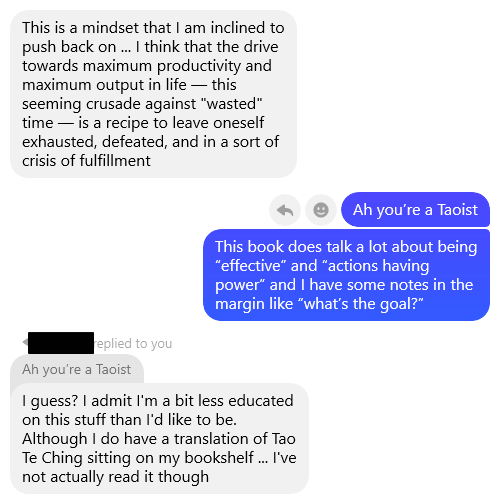
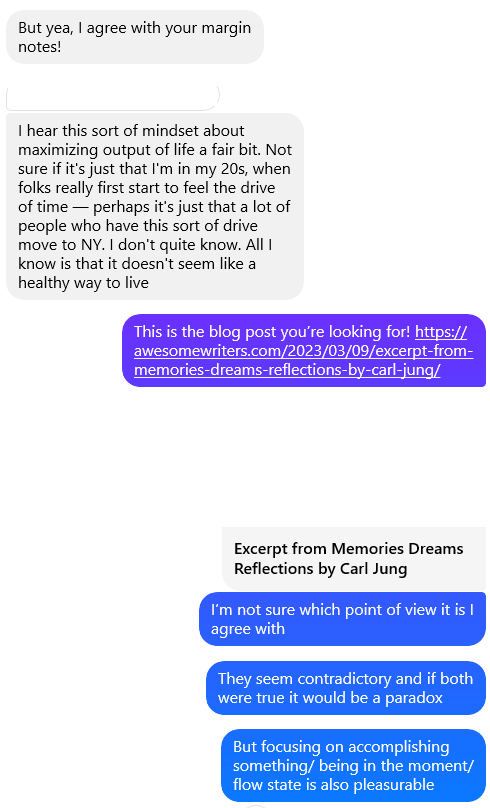
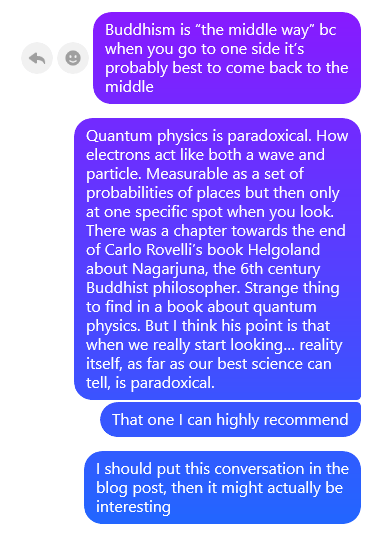
    This is the Carl Jung “Memories Dreams Reflections” blog post I sent a link to. And here’s a link to Helgoland by Carlo Rovelli.

  • Lady Marian is a Firecracker

    March 16th, 2023

    Roger Lancelyn Green: The Adventures of Robin Hood

    My kids are 7 and just shy of 10 years old and The Adventures of Robin Hood is a great bedtime book. The characters and the dialogue are natural and Green isn’t trying to impress with esoteric words (like “esoteric”) The prose is plain but poetic and a pleasure to read aloud.

    Lady Marian came suddenly into the room, clad in Lincoln green, with a quiver of arrows at her side and a bow in her hand.

    “How now?” roared her father. “Where are you off to now, wench?”

    “To the greenwood,” said Marian calmly.

    “That you shall not!” bellowed Lord Fitzwalter.

    “But I am going,” said Marian.

    “But I will have up the drawbridge.”

    “But I will swim the moat.”

    “But I will secure the gates.”

    “But I will leap from the battlement.”

    “But I will lock you in an upper chamber.”

    “But I will shred the tapestry and let myself down.”

    “But I will lock you in a turret where you shall only see light through a loophole.”

    “But I will find some way of escape. And, father, while I go freely, I shall return willingly. But once shut me up, and if I slop out then, I shall not return at all… Robing waits for me in the greenwood, and the knot half-tied yesterday can so easily be tied completely.”

    “Well spoken, lady,” cried the Friar.

    “Ill spoken Friar!” thundered Lord Fitzwalter.

    – Roger Lancelyn Green, The Adventures of Robin Hood

    Looking at Green’s list of fiction novels on his Wikipedia page, I’m sure this will not be the last book of his that I read, maybe for myself and not as a bedtime story. I will give it a Google and see which of his books have the best reviews but “Tales of the the Greek Heroes: Retold From the Ancient Authors” caught my eye (I enjoyed the Plutarch’s Alexander and Caesar biographies but there is no way I’m going to make it through that tomb, even if Plutarch is fairly readable, it’s definitely not grade school prose)

    “The Book of Nonsense” also caught my eye because I just bought “A Book of Nonsense” by Edward Lear (a picture book of nonsensical limericks) a couple weeks ago. Ok, I’ve convinced myself, I just bought “THE Book of Nonsense” by Roger Lancelyn Green. I am rather fond of nonsense. It looks like it edited by Green… and maybe written by many authors? I’m not quite sure from the descriptions. But like I said, if it’s nonsense I’m sure I won’t be disappointed!

    I added The Tale of Troy to just reach the $15 required for free shipping. The Book of Nonsense, I got the same edition that they are selling as a collectible for $30 for $8. It was printed in 1957. Tale of Troy, January 1958. I like to get old books if they aren’t more expensive. I’ve got some good ones from Thriftbooks. If they come with someone’s “Property of…” inscription inside the cover, that’s better. I like to imagine who they were and what happened to them.

    A random tangential conclusion: “Cybernetics: Or Control and Communication in the Animal and the Machine” by Norbert Weiner comes to mind. Inside the front and back cover were old articles from the early 1950s, one from Time magazine. Oh boy, that was a great ThriftBooks surprise delivery for a dork like myself! I sent pictures to my coworkers. They were overwhelmed with happiness for me, I’m sure.

  • Anaximander thought of Evolution?!?

    March 14th, 2023

    Excerpt from “Anaximander and the Birth of Science” by Carlo Rovelli

    There is another area in which Anaximander’s naturalism appears to be of nearly miraculous success: his reflections on the origins of life and human beings. According to Anaximander, life begins in the sea. He refers unequivocally to an evolution of living species connected with the evolution of climate conditions. First come marine species, which, as the earth dries up, migrate and adapt to dry land. He wonders which living beings might have brought forth the first humans. These issues would return only in recent centuries, with Darwin, with the momentous results we all know. With all their limits, the fact that these ideas are already present in the sixth century before the Common Era is breathtaking.

    – Carlo Rovelli, “Anaximander and the Birth of Science”, chapter titled “Atmospheric Phenomena”

    What must it have been like for Anaximander? Imagine being able to conceive of the evolution of species at a time when everyone only believed in the law of cause in a superficial way. Stub your toe and it hurts, no one at any time would fail to understand cause and effect in that way. But unexplainable phenomenon… It’s more like there was no unexplainable phenomenon because any unexplainable event was attributed to the will of The Gods.

    The other books I’ve read by Carlo Rovelli are about exactly this border between the explainable and the unexplainable. The point where modern science reaches it’s limits. I’m enjoying Anaximander but it will be pretty difficult to oust Helgoland from the top position on my favorite Carlo Rovelli list.

    One more thought about Anaximander, what if it was the other way around? Imagine trying to convince people that lightning was actually Zeus smiting the earth when in a bad mood. Imagine how people would respond if you told them that’s what you believed.

    But it was probably worse for Anaximander because at least today we know that the majority of our ancestors believed just about everything was the will of The Gods, so the idea that someone would believe that again is not foreign to us. But Anaximander… he must have been even more of an outcast.

    But he wrote and worked and his ideas were read and considered. (Carlo makes a point of noting that his ideas were considered but were never fully adopted as truth.) So maybe it wasn’t so bad for Anaximander.

    It seems he was smart enough to speak and write heretical ideas and not get himself executed. Perhaps not his greatest achievement but I’m sure that was important to him.

  • Anyone who takes the sure road is as good as dead

    March 14th, 2023

    “Memories Dreams Reflections” by Carl Jung, “Visions” chapter

    “Anyone who takes the sure road is as good as dead” is the most poignant and pithy one liner in the short chapter titled Visions dedicated solely to the visions that Jung had after his heart attack in 1944. The chapter starts with a description of an out-of-body experience where Jung floats above the earth and towards a granite temple.

    “It was as if I now carried along with me everything I had ever experienced or done, everything that had happened around me.”

    “There was no longer any regret that something had dropped away or been taken away. On the contrary: I had everything that I was, and that was everything.”

    “My life as I lived it had often seemed to me like a story that has no beginning and no end. I had the feeling that I was a historical fragment, an excerpt for which the preceding and succeeding text was missing. My life seemed to have been snipped out of a long chain of events, and many questions had remained unanswered. Why had it taken this course?”

    For it seemed to me as if behind the horizon of the cosmos
    a three-dimensional world had been artificially built up, in which
    each person sat by himself in a little box. And now I should have to convince myself all over again that this was important! Life and the
    whole world struck me as a prison, and it bothered me beyond
    measure that I should again be finding all that quite in order.

    It is impossible to convey the beauty and intensity of emotion during
    those visions. They were the most tremendous things I have ever experienced. And what a contrast the day was: I was tormented and
    on edge; everything irritated me; everything was too material, too
    crude and clumsy, terribly limited both spatially and spiritually. It was
    all an imprisonment, for reasons impossible to divine, and yet it had
    a kind of hypnotic power, a cogency, as if it were reality itself, for all
    that I had clearly perceived its emptiness.

    The insight I had had, or the vision of the end of all things, gave me the courage to undertake new formulations. I no longer attempted to put across my own opinion, but surrendered myself to the current of my thoughts.

    Something else, too, came to me from my illness. I might formulate
    it as an affirmation of things as they are: an unconditional “yes” to
    that which is, without subjective protests acceptance of the
    conditions of existence as I see them and understand them,
    acceptance of my own nature, as I happen to be.

    It was only after the illness that I understood how important it is to
    affirm one’s own destiny. In this way we forge an ego that does not break down when incomprehensible things happen; an ego that endures, that endures the truth, and that is capable of coping with the world and with fate. Then, to experience defeat is also to experience victory. Nothing is disturbed neither inwardly nor outwardly, for one’s own continuity has withstood the current of life and of time. But that can come to pass only when one does not meddle inquisitively with the workings of fate.

    I have also realized that one must accept the thoughts that go on within oneself of their own accord as part of one’s reality.

    The strangest part of that chapter may be that Jung predicted the death of his doctor and his prediction was (unfortunately for the doctor) accurate. Part of his vision he writes:

    It was my doctor, Dr. H. or, rather, his likeness framed by a golden chain or a golden laurel wreath. I knew at once: “Aha, this is my doctor, of course, the one who has been treating me. But now he is coming in his primal form, as a basileus of Kos.”

    Then later:

    I was worried about him. “His life is in danger, for heaven’s sake! He has appeared to me in his primal form! When anybody attains this form it means he is going to die, for already he belongs to the ‘greater company’!” Suddenly the terrifying thought came to me that Dr. H. would have to die in my stead. I tried my best to talk to him about it, but he did not understand me. Then I became angry with him. “Why does he always pretend he doesn’t know he is a basileus of Kos? And that he has already assumed his primal form? He wants to make me believe that he doesn’t know!” That irritated me. My wife reproved me for being so unfriendly to him. She was right; but at the time I was angry with him for stubbornly refusing to speak of all that had passed between us in my vision. “Damn it all, he ought to watch his step. He has no right to be so reckless! I want to tell him to take care of himself.” I was firmly convinced that his life was in jeopardy.

    In actual fact I was his last patient. On April 4, 1944 I still remember the exact date I was allowed to sit up on the edge of my bed for the first time since the beginning of my illness, and on this same day Dr. H. took to his bed and did not leave it again. I heard that he was having intermittent attacks of fever. Soon afterward he died of septicemia. He was a good doctor; there was something of the genius about him. Otherwise he would not have appeared to me as a prince of Kos.

    Throughout the book Jung laments the fact that as technology rapidly develops, we put all faith in science, and the spiritual and mystical is more and more thought to be ridiculous and laughable. His doctor did not believe him. Coincidence? Maybe. At one point Jung describes his argument with Freud about events occurring that seem to be unexplainable by pure chance or coincidence. (In this video he talks about this belief.)

    What is easier for the modern academic to accept is more of a Malcolm Gladwell “Blink” style explanation: perhaps Jung knew that the doctor was going to die because he observed characteristics in the doctor that he had previously observed in other’s close to death, but his conscious mind was not able to articulate those observations. And so his unconscious mind articulated these observations in the form of an image, the doctor as a “basileus of Kos.”

    I won’t speculate further. But I understand this exchange a little better with the more Jung I read:

    Many years ago, when one of his daughters interviewed him as part of a school project and asked what his religion was, Martin, a nonobservant Jew, answered, “Oh, honey, I’m a Jungian.”

    Sara Corbett, “The Holy Grail of the Unconscious“

  • Hunting the White Falcon

    March 12th, 2023

    Excerpt from “Journey to Ixtlan” by Carlos Castaneda

    It all began with my grandfather’s explosion of anger upon taking a count of his young Leghorn chickens. They had been disappearing in a steady and disconcerting manner. He personally organized and carried out a meticulous vigil, and after days of steady watching we finally saw a big white bird flying away with a young Leghorn chicken in its claws. The bird was fast and apparently knew its route. It swooped down from behind some trees, grabbed the chicken and flew away through an opening between two branches. It happened so fast that my grandfather had hardly seen it, but I did and I knew that it was indeed a falcon. My grandfather said that if that was the case it had to be an albino.

    We started a campaign against the albino falcon and twice I thought I had gotten it. It even dropped its prey, but it got away. It was too fast for me. It was also very intelligent; it never came back to hunt on my grandfather’s farm.

    I would have forgotten about it had my grandfather not needled me to hunt the bird. For two months I chased the albino falcon all over the valley where I lived. I learned its habits and I could almost intuit its route of flight, yet its speed and the suddenness of its appearance would always baffle me.

    I could boast that I had prevented it from taking its prey, perhaps every time we had met, but I could never bag it.

    In the two months that I carried on the strange war against the albino falcon I came close to it only once. I had been chasing it all day and I was tired. I had sat down to rest and fell asleep under a tall eucalyptus tree. The sudden cry of a falcon woke me up. I opened my eyes without making any other movement and I saw a whitish bird perched in the highest branches of the eucalyptus tree. It was the albino falcon. The chase was over. It was going to be a difficult shot; I was lying on my back and the bird had its back turned to me. There was a sudden gust of wind and I used it to muffle the noise of lifting my .22 long rifle to take aim. I wanted to wait until the bird had turned or until it had begun to fly so I would not miss it.

    But the albino bird remained motionless. In order to take a better shot I would have needed to move and the falcon was too fast for that. I thought that my best alternative was to wait. And I did, a long, interminable time. Perhaps what affected me was the long wait, or perhaps it was the loneliness of the spot where the bird and I were; I suddenly felt a chill up my spine and in an unprecedented action I stood up and left. I did not even look to see if the bird had flown away.

    – Carlos Castaneda, Journey to Ixtlan, Chapter 4: Death as an Advisor

    I picked up this book because along with “History of the Peloponnesian War” by Thucydides, it was recommended by Robert Greene as one of the two books that had the most profound effect on him. Greene is best known for “The 48 Laws of Power” but this book doesn’t seem to be focused on obtaining “power” in the common way that “power” is understood, meaning the ability to control the world (and people) to suit one’s personal desires.

    Instead, it’s a book that’s more about mysticism and timeless knowledge. The character teaching and explaining this knowledge to Carlos Castaneda (the introduction explains that the book is based on actual events and conversations, however embellished) is Juan Matus, or “Don Juan” and the very first line of the introduction describes Don Juan as a “Yaqui Indian sorcerer.”

    After reading the introduction and the first chapter I must admit that I was a bit cynical about how I would feel about this book, whether it was worth reading or not. It reminds me of “Way of the Peaceful Warrior” which I read when I was in 7th grade. It was my introduction to philosophy and mysticism and will always be an important book to me, but was more revelatory for me as a 7th grader (and now I am an old man!) I think I picked up “Way of the Peaceful Warrior” again in college or shortly after and quickly put it down, and I thought my relationship to “Journey to Ixtlan” might be similar. (I was particularly critical of the parenting advice that Don Juan gave Castaneda to relay to his friend.)

    But I’ve been enjoying these last chapters and even if the revelatory ideas I’ve heard before, it seems to be proving worth my time.

    There are a lot of one-liner quotes that I could pick out, let me just pick a couple:

    “But, you yourself know who you are, don’t you?” I interjected.

    “You bet I… don’t,” he exclaimed and rolled on the floor, laughing at my surprised look.

    “You take yourself too seriously,” he said slowly. “You are too damn important in your own mind. That must be changed! You are so goddamn important that you feel justified to be annoyed with everything.”

    As long as you feel that you are the most important thing in the world you cannot really appreciate the world around you. You are like a horse with blinders, all you see is yourself apart from everything else.

    And to relate to Robert Greene and power:

    Don Juan’s reply was that the young man was a fool who did not know what he was looking for. He did not know what “power” was, so he could not tell whether or not he had found it.

←Previous Page
1 2 3 4
Next Page→

Blog at WordPress.com.

  • Is 50/50 Division Human Nature
  • A Frightening Vacuum
  • A Strange Mix: The Suffering Samsari Hath No Place to Lay His Head
  • Fanatical Doubt: Who comes to mind?
  • Portrait of a Lady: A Couple Quotes
  • Is 50/50 Division Human Nature
  • A Frightening Vacuum
  • A Strange Mix: The Suffering Samsari Hath No Place to Lay His Head
  • Fanatical Doubt: Who comes to mind?
  • Portrait of a Lady: A Couple Quotes
  • Is 50/50 Division Human Nature
  • A Frightening Vacuum
  • A Strange Mix: The Suffering Samsari Hath No Place to Lay His Head
  • Fanatical Doubt: Who comes to mind?
  • Portrait of a Lady: A Couple Quotes
 

Loading Comments...
 

    • Subscribe Subscribed
      • AwesomeWriters
      • Already have a WordPress.com account? Log in now.
      • AwesomeWriters
      • Subscribe Subscribed
      • Sign up
      • Log in
      • Report this content
      • View site in Reader
      • Manage subscriptions
      • Collapse this bar