I just started this YouTube video , it starts with Chapter 4 and I quickly realized I’ve heard it before. (Warning: this is more of a Twitter post than a blog post…)
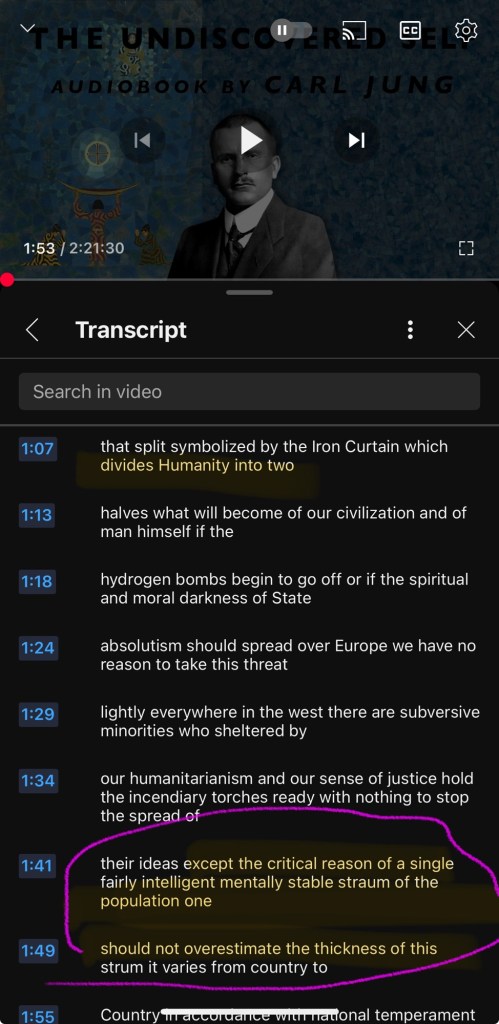
Carl mentions the iron curtain that divides humanity in two.
I’ve been actively not keeping up with the news. It’s inflammatory. It’s designed to be. My suspicion is, which I am not the first to express, it is stolen from some many people I imagine – my suspicion is the news is designed to raise blood pressure a) for engagement but also b) the poor Republicans hate the poor Democrats and vice versa. Who is left unhated on? And what news stories go unnoticed bc people are occupied by these strong gut feelings and beliefs around certain topics, that may not be unimportant, but they might be arguably less important than the news stories that don’t make the front page? While the insults are hurled by the powerless to the powerless, and thrown right back but with more force, like a Hatfield McCoy feud – while this feud rages, who sits on the the hill and watches the action while ordering rounds of lemonade (or maybe martinis and X-years-aged whiskey)
There is no more iron curtain. But people seem to be angry as ever, or more so, while no soldiers die, and less people live in abject poverty, we still divide ourselves 50/50.
Didn’t tribes divide into relatively equal numbers, a presumably ideal group number being about 120 or so if I recall? Did cities, provinces, towns develop into relatively equal numbers throughout history?
Say you are given a choice between joining a group of 40 or a group of 60? If it’s the Eve of a battle, perhaps you choose differently, but if you choose the group of 40 over the larger group, are your chances better that there will be a larger dinner portion assuming resources are somewhat equal? You have a better chance of being more relatively important in the smaller group right?
Like the Eve-of-Battle scenario, I could come up with many scenarios where the larger group is the way to go. Just a thought… hopefully the bot that reads the blog I haven’t posted in in x months enjoys it. Cross your fingers for me, hopefully I have more time for reading and writing in the not-so-distant future.
When he says “sheltered by our humanitarianism and sense of justice” – I think this could be misinterpreted, more or less taken out of context and used to justify negative feelings towards the other side, regardless of which side said justified sits on and which crap news station is the only one watched “in this household”
Both sides, all people in… the world – every single person KNOWS that they stand with the just, the people who see things as they are – and not with the dangerous imbeciles who deserve the harshest of penalties.
Carl had WW2 and the Cold War. But sometimes I wonder… on the surface things look very different but…how different, modern, “advanced” are we really? Are we still not dividing in two? To focus on only one thing of very many examples. Do the myths and symbols still not repeat themselves, very nearly unchanged, like a new coat of paint or a bi-monthly haircut?
***
I went to save that Carl video to watch later, I rarely click on these “short” videos (maybe it’s because of the Washington monument, perhaps the largest and most distinguished Freud/Carl coined ______ symbol in the world) – anyway… I watched it. Synchronicity seeming to actually be a thing, it is strangely applicable to this post.
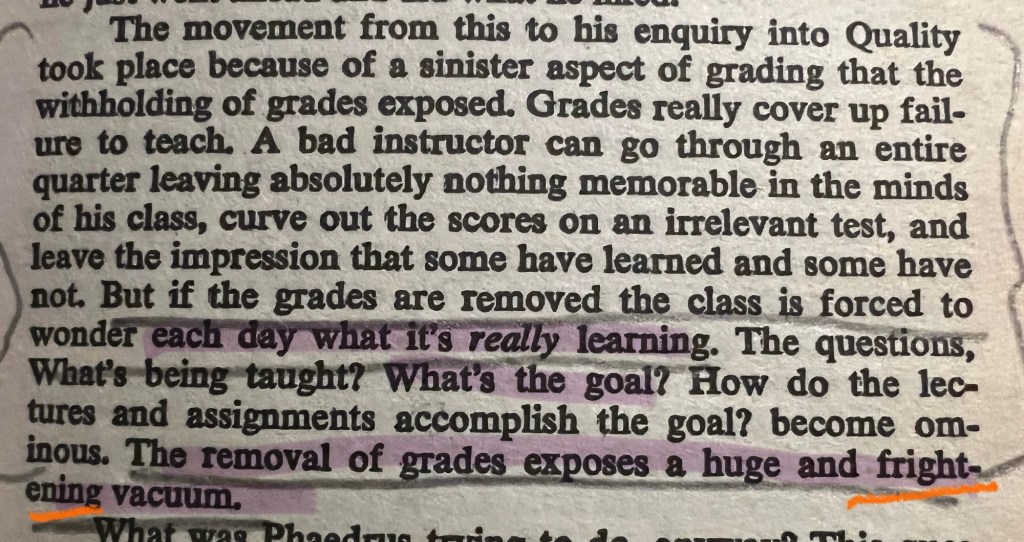
“The removal of grades exposes a huge and frightening vacuum.”
I’m starting a company in the near future and I haven’t done much pitching it. Hopefully there is not much of this kind of thing required, at least on my part. I’m not a salesman: I’m way too honest and ridiculous, an open book, which in some cases may be a positive quality, in others… not at all positive.
And my “jokes”, my favorite being the kind where it’s not clear if it is a joke or not, I think I can be funny, but sometimes… it’s not that I don’t care about the recipient’s take on it… I have a perhaps-not-good and definitely a not-always-good habit of working through my thoughts in long meandering messages which is… uncommon to put it mildly, and to put it accurately- sometimes I sound like a lunatic.
My messages are like these blog posts – unstructured, full of tangents (like this one) that may become the bulk of the writing, and, if there materializes a “point” at all, it’s not the one I had in mind when I started tapping keys, and indeed sometimes what it was I started with.
Sometimes it’s a “talking to the duck” situation and I work through my thoughts and something becomes clearer to me, maybe a conclusion of some sort is reached – at least this is what I tell myself to justify the behavior.
A good tone and style for a journal. Not for a sales-type-pitch or any time you want someone to take you seriously.
In short, I’m not a salesman. This particular business and industry at least in part chosen because the sales aspect is a very small fraction of what’s required in other industries / for other types of businesses.
So… what was I saying? Right – I’m pitching this thing and I learned from a very intelligent founder that when you are starting a business the first order of business is to answer the question: “Who has tried this? Why did they fail?” or, if no examples exist: “Why has someone not done this?”
If you can answer that question and are dissuaded, the next question you ask is: “Why are YOU uniquely qualified to solve this problem?”
When I (try to) answer this second question, there are a couple main points, but if I continue I find myself essentially giving a life story. A long one. It’s amazing to me how almost everything significant in my life seems to apply in some way. Sometimes very unlikely and unusual things. I get something like the feeling you might get if you are standing inches away from a mosaic and then start to back up and a picture emerges from all the individual pieces.
But the pieces are things in my life! Things that happened to me and sometimes carry emotion, I won’t say “emotional baggage” because the emotions are both positive and negative, depending on the mosaic block. A better analogy still is a mosaic that is composed of tiny square pictures, each piece, its own story.
One of those blocks (and here is where I attempt to come full circle) is that about 10 years ago now, I took a year off of work to be the primary caretaker for my children while my ex wife was doing her medical residency. Full disclosure: It was later brought to my attention by both my ex and my lawyer, that this is viewed as less admirable when I include the fact that I did bring my kids to daycare, and I did quite a bit of snowboarding during that time – but before rendering judgement: the spent far less time in daycare than other children, sometimes just an hour or two, while I did some traditionally feminine activity like grocery shopping or cooking or cleaning.
I was very much the primary caretaker for both the children and the home (not a negligent and juvenile snowboarder-father) and it was… unsettling in many ways, the role of house-husband.
I learned very well that whatever someone tells you, chances are overwhelmingly in favor that they do not respect a stay-at-home dad, even though they may truly believe that they do, and the non-respect is also overwhelming.
One anecdote: I was paying every bill and had paid every bill for… ever. There were student loans but if there weren’t then “put my wife through med school” would be accurate. I was able to not work then because I had received a decent payout from a successful startup I was part of, where I had worked… a lot and very hard. All the same, my old-bitch neighbor, upon hearing that I was a stay-at-home dad remarked, “Oh! So you are a kept man!”
Another: it took me almost three months to find a job. I thought people would say “That’s awesome! You earned enough money to be able to take that time to raise your children! Wow!” Nope. I eventually got a contract role, learned nothing except a couple things about bureaucracy and red tape, and it was over in maybe 4 months. I was the same person with the same skills walking out as walking in. In that next week I got 5 job offers. Stay-at-home dad – 3 months, 1 job offer. Employed dad – 1 week, 5 job offers. But just about every person these days will tell you – and honestly believe themselves: “I have the same respect for a stay-at-home dad as a working professional dad. What do you take me for?!? A fool who is affected by 1950s stereotypes! I am very much above and not susceptible to that bias, thank you very much!”
One more: I don’t think the judge in the divorce proceedings rendered the same judgment as he would have if I was a hardworking female who had taken care of the bills and children who was then divorced by her freshly minted M.D. husband.
One final one: My lawyer once told me, “It’s illegal in this state to video tape someone without their consent. We are not going to mention that – you could be charge with a crime.” At which point I thought for a couple seconds and said, “Wait hold on… you’re telling me that if she had a video of me…” at which point she cut me off and said “Oh – you’d be in jail. Yeah. Right now.”
It wasn’t my intention to write about father’s rights and sexism… I will just add: my ex and I get along very well and my wife, and her and her boyfriend, we’re happily raising five kids in total, all healthy and happy, so despite my complaints, a happy ending – one must trust the universe.
Ok now I will come full circle and say what I wanted to say when I started:
One of the unsettling things about that time when I was not working, I experienced this “frightening vaccuum.”
When you have a job, you get up, you get ready for work, you do your work, and then you’re tired, and if you happen to be not fatigued enough to ask yourself at the end of the day, “So what was the point? What did I accomplish?” Then the answer is obvious: you worked. Even if you scrolled through social media all day, you accomplished the receiving of that portion of your paycheck.
When you’re not working then you have to ask yourself – day after day: “Ok… so… what am I doing here? What would constitute an accomplishment today?” And hopefully you find some answer and then fulfill the goal you invented for yourself. Or… at the end of the day you might get a vacuum-type feeling.
And far more frightening: you might have the time to ask yourself: “ok… so what is ‘the big goal’?”
That question is sometimes difficult to answer and you may eventually find yourself reading Camus and wading into dark existential waters.
But one must trust the universe.
This is one of the mosaic pieces. If you’re planning on starting your own business, especially one unrelated to physical labor or a physical product, then you should have the ability to set a goal for yourself. If you only work when you have to… if you require a manager or slave driver to drive you… then you may be in for a shock and disaster if you start driving yourself.
A lot of people have told me “What would I do if I won the lottery? Well I’d relax of course! I’d drink margaritas and lie on the beach!”
And when I ask, “Yeah? For how long? Do you think you’d be happy doing that forever?”
The answer is usually, “OF COURSE!”
I have a paradoxical mix of pity and envy for these types. They are so into the carrot-and-stick game that they don’t ask the bigger questions. And that’s a bit sad and pitiable.
At the same time… they are so into the game that they don’t ask the bigger questions. And so they are not troubled by them! Which is enviable as one envies a Taoist monk.
Pity wins out. I have a suspicion that sometimes these types… that by the time they ask the bigger questions (and in every life, I imagine they come at some point) – when this time comes, they may find an answer, but it might be too late for them to do or accomplish the answer they have found. And… that is a situation I do not find enviable in the slightest.
“But why on earth, you might ask, should it be necessary for man to achieve, by hook or by crook, a higher level of consciousness?
This is truly the crucial question, and I do not find the answer easy. Instead of a real answer, I can only make a confession of faith. I believe that, after thousands and millions of years, someone had to realize that this wonderful world of mountains and oceans, suns and moons, galaxies and nebulae, plants and animals, exists.
This one was earlier in the video and is one of those quotes you would think someone said yesterday, if we paid a fraction of the attention to intellectuals. But is there anyone who speaks like this anymore? Why do I have to go back 50 or 60 or 70 years for a good quote? Maybe it has something to do with WW2 and the Cold War after. Finally, the quote:
We have let the house our fathers built fall into decay, and now we try to break into Oriental palaces that our fathers never knew. Anyone who has lost the historical symbols and cannot be satisfied with substitutes is certainly in a very difficult position today: before him there yawns the void, and he turns away from it in horror. What is worse, the vacuum gets filled with absurd political and social ideas, which one and all are distinguished by their spiritual bleakness.
“Memories Dreams Reflections” by Carl Jung, “Visions” chapter
“Anyone who takes the sure road is as good as dead” is the most poignant and pithy one liner in the short chapter titled Visions dedicated solely to the visions that Jung had after his heart attack in 1944. The chapter starts with a description of an out-of-body experience where Jung floats above the earth and towards a granite temple.
“It was as if I now carried along with me everything I had ever experienced or done, everything that had happened around me.”
“There was no longer any regret that something had dropped away or been taken away. On the contrary: I had everything that I was, and that was everything.”
“My life as I lived it had often seemed to me like a story that has no beginning and no end. I had the feeling that I was a historical fragment, an excerpt for which the preceding and succeeding text was missing. My life seemed to have been snipped out of a long chain of events, and many questions had remained unanswered. Why had it taken this course?”
For it seemed to me as if behind the horizon of the cosmos a three-dimensional world had been artificially built up, in which each person sat by himself in a little box. And now I should have to convince myself all over again that this was important! Life and the whole world struck me as a prison, and it bothered me beyond measure that I should again be finding all that quite in order.
It is impossible to convey the beauty and intensity of emotion during those visions. They were the most tremendous things I have ever experienced. And what a contrast the day was: I was tormented and on edge; everything irritated me; everything was too material, too crude and clumsy, terribly limited both spatially and spiritually. It was all an imprisonment, for reasons impossible to divine, and yet it had a kind of hypnotic power, a cogency, as if it were reality itself, for all that I had clearly perceived its emptiness.
The insight I had had, or the vision of the end of all things, gave me the courage to undertake new formulations. I no longer attempted to put across my own opinion, but surrendered myself to the current of my thoughts.
Something else, too, came to me from my illness. I might formulate it as an affirmation of things as they are: an unconditional “yes” to that which is, without subjective protests acceptance of the conditions of existence as I see them and understand them, acceptance of my own nature, as I happen to be.
It was only after the illness that I understood how important it is to affirm one’s own destiny. In this way we forge an ego that does not break down when incomprehensible things happen; an ego that endures, that endures the truth, and that is capable of coping with the world and with fate. Then, to experience defeat is also to experience victory. Nothing is disturbed neither inwardly nor outwardly, for one’s own continuity has withstood the current of life and of time. But that can come to pass only when one does not meddle inquisitively with the workings of fate.
I have also realized that one must accept the thoughts that go on within oneself of their own accord as part of one’s reality.
The strangest part of that chapter may be that Jung predicted the death of his doctor and his prediction was (unfortunately for the doctor) accurate. Part of his vision he writes:
It was my doctor, Dr. H. or, rather, his likeness framed by a golden chain or a golden laurel wreath. I knew at once: “Aha, this is my doctor, of course, the one who has been treating me. But now he is coming in his primal form, as a basileus of Kos.”
Then later:
I was worried about him. “His life is in danger, for heaven’s sake! He has appeared to me in his primal form! When anybody attains this form it means he is going to die, for already he belongs to the ‘greater company’!” Suddenly the terrifying thought came to me that Dr. H. would have to die in my stead. I tried my best to talk to him about it, but he did not understand me. Then I became angry with him. “Why does he always pretend he doesn’t know he is a basileus of Kos? And that he has already assumed his primal form? He wants to make me believe that he doesn’t know!” That irritated me. My wife reproved me for being so unfriendly to him. She was right; but at the time I was angry with him for stubbornly refusing to speak of all that had passed between us in my vision. “Damn it all, he ought to watch his step. He has no right to be so reckless! I want to tell him to take care of himself.” I was firmly convinced that his life was in jeopardy.
In actual fact I was his last patient. On April 4, 1944 I still remember the exact date I was allowed to sit up on the edge of my bed for the first time since the beginning of my illness, and on this same day Dr. H. took to his bed and did not leave it again. I heard that he was having intermittent attacks of fever. Soon afterward he died of septicemia. He was a good doctor; there was something of the genius about him. Otherwise he would not have appeared to me as a prince of Kos.
Throughout the book Jung laments the fact that as technology rapidly develops, we put all faith in science, and the spiritual and mystical is more and more thought to be ridiculous and laughable. His doctor did not believe him. Coincidence? Maybe. At one point Jung describes his argument with Freud about events occurring that seem to be unexplainable by pure chance or coincidence. (In this video he talks about this belief.)
What is easier for the modern academic to accept is more of a Malcolm Gladwell “Blink” style explanation: perhaps Jung knew that the doctor was going to die because he observed characteristics in the doctor that he had previously observed in other’s close to death, but his conscious mind was not able to articulate those observations. And so his unconscious mind articulated these observations in the form of an image, the doctor as a “basileus of Kos.”
I won’t speculate further. But I understand this exchange a little better with the more Jung I read:
Many years ago, when one of his daughters interviewed him as part of a school project and asked what his religion was, Martin, a nonobservant Jew, answered, “Oh, honey, I’m a Jungian.”
“From Tozeur I went on to the oasis of Nefta. I rode off with my dragoman early in the morning, shortly after sunrise. Our mounts were large, swift-footed mules, on which we made rapid progress. As we approached the oasis, a single rider, wholly swathed in white, came toward us. With proud bearing he rode by without offering us any greeting, mounted on a black mule whose harness was banded and studded with silver. He made an impressive, elegant figure. Here was a man who certainly possessed no pocket watch, let alone a wrist watch; for he was obviously and unselfconsciously the person he had always been. He lacked that faint note of foolishness which clings to the European. The European is, to be sure, convinced that he is no longer what he was ages ago; but he does not know what he has since become. His watch tells him that since the “Middle Ages” time and its synonym, progress, have crept up on him and irrevocably taken something from him. With lightened baggage he continues his journey, with steadily-increasing velocity, toward nebulous goals. He compensates for the loss of gravity and the corresponding sentiment d’incompletitude by the illusion of his triumphs, such as steamships, railroads, airplanes, and rockets, that rob him of his duration and transport him into another reality of speeds and explosive accelerations.”
This excerpt is from the chapter titled “Travels”. I posted this paragraph because I enjoyed the poetic description of “progress.”
One can only imagine what Jung’s thoughts on the internet technologies would be.
Yesterday I ordered a copy of The Red Book from Amazon for twenty something dollars, apparently at a large discount. Free overnight shipping. I thought that was a cheap price for any book with illustrations and… that’s because this book doesn’t have the illustrations. It’s “A Reader’s Edition” Well… at $20 I’m not going bother returning it. And maybe it will be necessary when I do manage to procure a copy of the actual Red Book, because it’s written in calligraphy, in German I believe. So to appreciate the artwork, I guess I need the German calligraphy. I don’t want some fake Jung calligraphy… So perhaps not wasted money in the long run.
But looking into it just a little further, first, it doesn’t look like it’s going to be cheap to find a copy. Amazon currently has it listed for $214, a 27% discount from $300. That’s not exactly a cheap book.
Biographers and critics have disagreed whether these years in Jung’s life should be seen as “a creative illness”, a period of introspection, a psychotic break, or simply madness.
Yesterday I wrote that it sounds like Jung walked a razor’s edge between sanity and insanity. Still… I’m surprised that… I read his own descriptions of this time period and I didn’t understand the extent to which he was consumed by his thoughts and mission, his “confrontations with the unconscious”.
I’ve seen some footage of interviews he did towards the end of his life on YouTube. As an old man he seemed witty and full of life. And humor.
How does a man with so many insights into the human condition, who has helped so many people with his poignant observations, how does that same man truly descend into madness?
I think when I was reading the memoirs I took what he was saying more figuratively than as intended…
Back to the book: it wasn’t published until 2009 (at $195) It’s interesting that it was kept from the public for so long. To who’s benefit?
It’s currently at the Library of Congress, donated also in 2009. So I can save the $2-300 and just go check it out? How is it that the United States ended up with the original and not Switzerland? Maybe there is a story there worth digging into.
Some thoughts inspired by the chapter “Confrontations with the Unconscious” from Carl Gustav Jung’s autobiography “Memories, Dreams, Reflections”
I mentioned that I was reading Memories, Dreams, Reflections by Carl Jung to a coworker and he told me that was funny because there was some controversy this past week about a New York Times article by Kevin Roose where he asked the new ChatGPT powered Bing (search engine) about it’s shadow self. I’m only halfway through the article and it’s getting interesting! Perhaps it’s now important for even our technology to “know thyself”
One thought is that Jung’s theme concerning the importance of understanding the unconscious, integrating the shadow, or (summarily) to “know thyself,” seems to go hand in hand with walking a fine line between sanity and insanity, or normality and abnormality. Concerning his exploration of his unconscious he makes the observation:
“It is of course ironical that I, a psychiatrist, should at almost every step of my experiment have run into the same psychic material which is the stuff of psychosis and is found in the insane.”
That is unambiguous. And makes me wonder: if C.G. Jung, a man of profound intelligence and wit, and a man who makes the top 10 when it comes to investigating his own mind and the mind in general, if this man openly declares himself to border on insanity, what does that say about the rest of us? And what does that say about… me?
Earlier in Memories, Dreams, and Reflections he discusses a fellow psychiatrist whom he encouraged to undergo psychoanalysis with the assertion that in order to be able to help anyone else, he must first understand himself. This man was on the surface completely ordinary and identified as so. Normal job, family, hobbies, etc, etc, the whole 9 yards: a normal guy.
The man told Jung that he didn’t dream. Jung told him “You will soon” and noted that saying that to someone is enough to make any relatively normal person have and remember a dream that same night. (And sure enough, I had a dream that night and have continued to have and remember them since then and have started a dream journal, because if I don’t write them down right away, they are lost, I forget them. How many dreams have I forgotten in this way? That then gives me the impression that I don’t dream often?)
Anyway, Jung’s coworker patient continued to not dream for some weeks but then came in with a dream to share. The result: Jung ended the therapy. Told him: “You’re right, you are normal!” when he was anything but. That’s not an exact quote, let me find some:
“I have had some astonishing experiences with ‘normality.’”
“I realized that his normality was a compensation.”
“His emphatic normality reflected a personality which would not have been developed but simply shattered by a confrontation with the unconscious.”
He was too normal to be helped!
This makes me think of people and times when I’ve wondered to myself: should I say what I really think? Would that help them or is it too much?
When someone spends their life pursuing one course of action and one set of beliefs… sometimes it is past the point where you can do any good by introducing a new belief or poking holes in their dogma. And this explains why most old people are so set in their beliefs. Once you commit past a certain point… you’ve got to see it through.
Jung states that he’s in favor of psychotherapy by professionals but when it comes to the “layman” he holds the opinion that – yeah, check it out. A theme of this memoir indeed seems to be “know thyself.” Try to understand yourself. Question yourself. Because if you don’t… insanity awaits you!
But as far as practicing psychoanalysis on other’s, Jung has words of caution for the dinner table psychologist: “I am in favor of non-medical men studying psychotherapy and practicing it; but in dealing with latent psychoses there is a the risk of their making dangerous mistakes.”
I find this disturbingly relatable and to return to my thought: I think being honest is one of the most important ideals for a person to have, but again I wonder if at times I’ve said too much when I should have kept my mouth shut.
What is it that Marcus says? I didn’t find the quote I was looking for but this one will do: “It’s silly to try to escape other people’s faults. They are inescapable. Just try to escape your own.” The quote I was looking for was more specifically about not admonishing people if it’s not going to do them any good.
I wonder if I’ve made the mistake of violating that prescription… To act against both Jung and Marcus is surely a sin.
Taking a step back: so it’s true! The “normal people” are indeed the craziest of us! I’ve had this thought before (and the image of Christian Bale from “American Psycho” comes to mind) but it’s interesting to have some confirmation from perhaps the most respected psychologist.
“Unpopular, ambiguous, and dangerous, it is a voyage of discovery to the other pole of the world,” is how Jung describes the investigation of the unconscious. And he is critical of Nietzsche for losing himself in thought: “I was not a blank page whirling about in the winds of the spirit, like Nietzsche.” Jung shows great respect and admiration for Nietzsche at times but is straightforward about his opinion of the latter years: he lost it. Lost himself in thought. Delved so deep that he lost touch with reality. (What’s the story about the horse? I think he had a public breakdown when he witnessed a horse beaten and declared himself one with the horse while crying in the street. (Citation needed…))
So if this investigation is so dangerous then why do it? As I said earlier, Jung seems to be of the opinion that the dangers of not doing so are worse (until you reach that point of ‘normalcy’ where you the unconscious half of you is no longer reachable to yourself…).
A general theme of this memoir and maybe his work and philosophy in general seems to be: if you don’t investigate yourself / your unconscious / your shadow side, then you will never be a complete person, and the fracture between the two parts of yourself will cause you and those in your life a lot of pain and… you might end up going completely insane.
Well look at that… I’ve written an article and didn’t even stick to my original idea, or develop it. But now having further evidence of my skill of blabbering on… perhaps there is hope for this blog after all!
But having not stuck to the program, here is a more uplifting quote that I will end with:
“What a dreary world it would be if the rules were not violated sometimes!”
– C.G. Jung, Memories, Dreams, and Reflections, from the chapter titled “Confrontations with the Unconscious”
 AwesomeWriters